
The first question almost everyone asks when they call my office is what their case is worth. It's a fair question. You've been hurt, the bills are starting to show up, and you want to know where this is going. The answer I give, especially in the early days of a case, is that it's pretty tough to tell. There's no sticker price on an injury claim.
What I can give you on day one is a map. Every claim in California runs on a handful of questions: how badly you were hurt and how well that's written down, who was at fault, whose insurance is responsible and how much it carries, and how fast the evidence disappears. The kind of case you have changes which of those questions is hardest. A truck crash is a race to preserve data before a company's retention policy clears it. A slip and fall turns on what the store knew and when it knew it. A brain injury turns on symptoms a scan may never show.
The rest of this chapter covers what it costs to find out whether you have a case, and the questions I'd ask any firm before signing. None of it is advice about your case. Only a lawyer who has looked at your records and your policy can tell you what your facts mean.
But, if you're hiring a personal injury attorney and we take on the claim early on and it turns out that for whatever reason we can't pursue the claim, you're not gonna owe us a dime. We're not gonna pursue any kind of collection.
There is no sticker price on an injury case
The size of the crash tells you something. A more severe crash typically means a more valuable case, and a smaller one is generally worth less. That isn't always true, though, because value is dictated by the injuries. Someone can get hit at freeway speed on the I-5, the I-8 or the I-15 and recover just fine. Someone else gets rear-ended at a stoplight in what doesn't even look like a significant impact and turns out to be seriously hurt.
Lawyers sort the harm into economic damages, the losses you can put a number on, like medical bills and lost wages, and non-economic damages, like the pain of going through multiple surgeries. Chapter 2 goes through both.
I hate to give the lawyer answer of "it depends," but in these cases it's true. Once a case gets into treatment, we have a much better idea of where it's headed. Are the pain levels staying the same? Did they improve a little in the beginning and then go flat? Does the imaging show something a surgeon wants to fix? The treatment, and whether the person keeps getting better, drives the value more than anything you can see on the car.
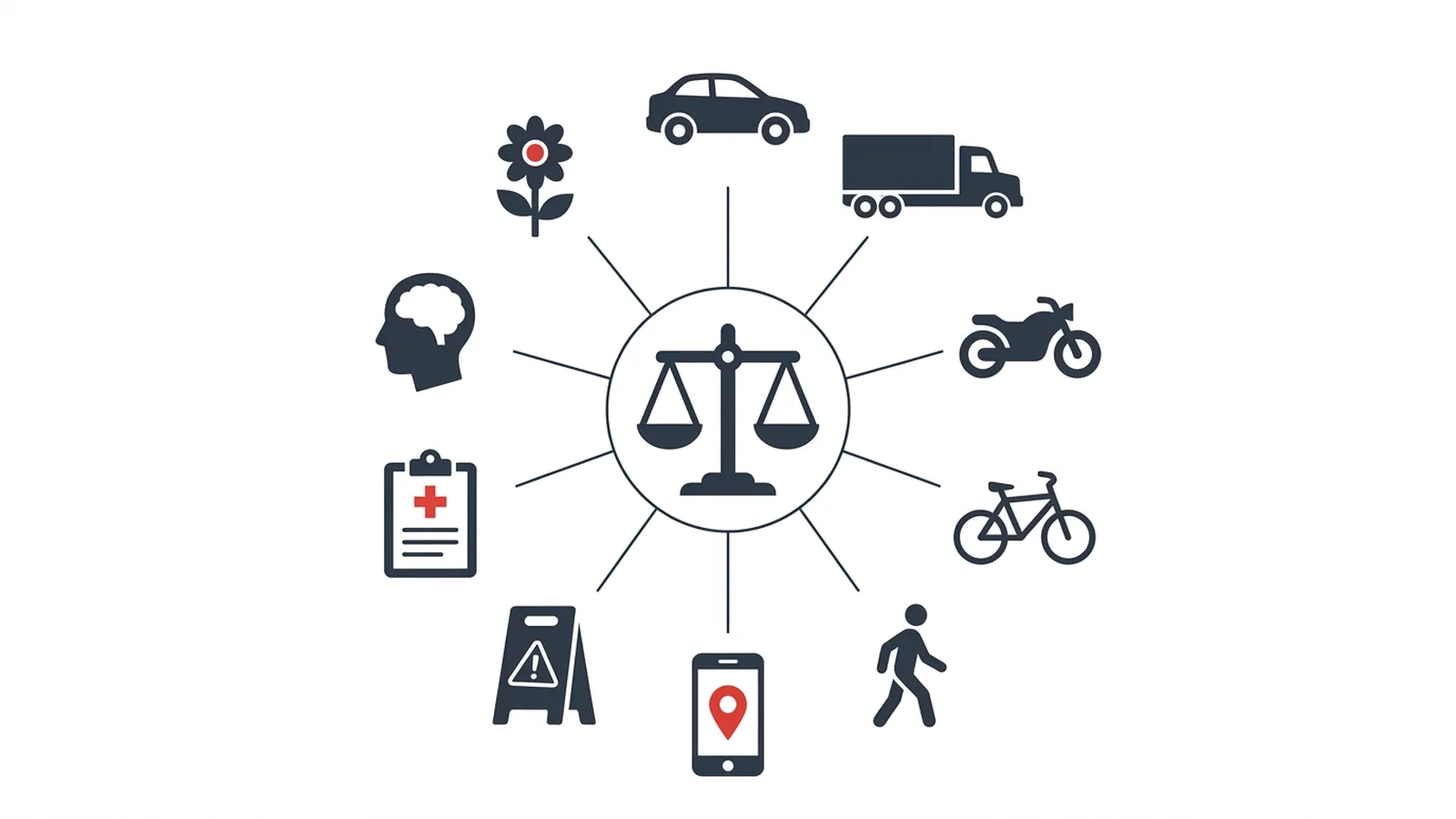
Nine kinds of cases, and the question that decides each
On the podcast's roundup episode I went through every kind of case my firm handles. They all share the basics above. Each one also has its own pressure point, the place where cases tend to be won or quietly lost.
- Car accidents. The documentation carries the case. When an injury is written down in a medical record, it changes the value of the claim. When it isn't, you're kind of running blind, telling the insurance company what happened with nothing on paper to back you up.
- Truck accidents. Many trucks carry dash cams, and most commercial trucks have an electronic logging device that records hours, speed, braking and often steering. If that footage isn't favorable to the company and no lawyer has sent a letter telling them to keep it, it can be discarded under a short retention policy. A preservation letter has to go out early.
- Brain injuries. These are often called invisible injuries. A CT will almost never show one unless there's an active bleed, and an MRI very rarely does. What proves a brain injury is consistent documentation of symptoms over time.
- Motorcycle accidents. In California, riding without a helmet does not wreck your claim. The insurance company can argue a helmet would have made a head injury less severe, which goes to value. An adjuster may also say lane splitting made you negligent, and that isn't the law in California.
- Bicycle accidents. Right of way and the Vehicle Code decide fault. When the driver had no insurance or not enough, your own uninsured or underinsured motorist coverage may pay. Where a road's design keeps producing crashes, a public entity or whoever designed or maintained the road can be responsible too.
- Pedestrian accidents. Drivers are supposed to scan for people and yield, especially at a crosswalk. Even when a pedestrian shares some of the blame, California's comparative negligence rule lets them recover a share of the damages.
- Uber and Lyft accidents. Which period the driver was in at the moment of the crash decides how much coverage exists, and the driver's personal auto policy is almost never the one in play.
- Slip and fall claims. It isn't enough to show the hazard was there. You have to show the property owner knew, or should have known, about it, and the surveillance footage that proves how long it was there can be recorded over within a day, two weeks or 30 days.
- Wrongful death. The claim belongs to the family, and who can bring it depends on how that family is structured. There's a short section on it at the end of this chapter.
Notice how often the clock comes up: truck data, store video, the weeks before a symptom gets written down. The filing deadlines run on a clock as well. A standard injury claim in California generally has two years. When a public entity is involved, like a city vehicle, a Caltrans truck or a city sidewalk, the claim may have to be presented within six months (California Government Code section 911.2). People get hurt, treat for seven, eight or nine months, decide they want to pursue a claim, and find out it's too late. Chapter 12 covers the deadlines step by step.
What it costs to find out whether you have a case
A lot of people hesitate before calling a lawyer because they aren't sure they'll need one. The pain seems manageable. They figure they'll wait and see how they feel in a few months. I understand that, and it's the situation the way my firm charges is built for.
We work on contingency. We don't get paid unless we recover. If we need to file a lawsuit tomorrow to preserve a claim, we front those costs, so the client pays nothing up front. When we take a claim early and it turns out we can't pursue it, that's part of the cost of doing business. Sometimes we do work for free, but at least the client walks away with answers. Whatever firm you talk to, the fee terms belong in writing, and California requires a contingency fee agreement to be in a written contract (Business and Professions Code section 6147). Read it, and ask about anything that isn't clear.
So my advice, if there's any doubt, is to talk to a lawyer early. If it turns out you're fine, maybe the claim settles, or maybe it just gets dropped down the line, and either way you don't owe money. What you can't do later is recover the store video that was recorded over at day 30 or the medical record that never got made in week two. There are often things you aren't aware of that can dramatically affect a case within the first two weeks to a month, and if certain steps aren't taken, that information disappears.
Questions to ask any firm before you sign
The firm you pick matters, and you can learn a lot about it in one conversation. Start with how involved they'll be during your medical care. Some firms tell clients "let us know when you're done treating" and wait. The approach I'd look for sounds different: go to your primary care doctor and then call us right away so we know what happened. If they referred you to a specialist, call us right after that appointment. That way the firm gets the records, and it has a real understanding of what's going on while there's still time to act on it.
That involvement matters because questions usually come after the appointment. People are nervous in front of a doctor. They're unsure, they're thinking about a lot of things at once, and they have 20 or 30 minutes. Later they wonder about the surgery that was recommended or the procedure they didn't understand. A good firm helps you work through those questions and steers you toward the right next step.
Next, listen to how the firm explains things. You should walk out feeling comfortable, with a pretty good understanding of where you stand. At my firm we explain the law, we explain the medicine and we explain the process, in everyday language, and we'll explain it a different way if the first one didn't land. I sit down with everyone from the most junior person on staff up to my attorneys and walk through the medicine in detail: why a procedure is done, when it's warranted, when it isn't. A lot of people are confused, overwhelmed or intimidated by doctors, medicine and insurance companies. Part of our job is to prepare clients for that so they can advocate for themselves.
Finally, ask about the evidence that's specific to your kind of case. In a truck crash, ask whether a preservation letter went out. In a slip and fall, ask how they plan to get the sweep logs and the footage. For anyone who already has a lawyer, my test is short: "If you're not getting good answers from your attorney or they're not paying close attention to medical, it's time to get a new attorney."
Wrongful death claims, briefly
When someone dies because of another person's negligence, there are often a lot of people involved: children, a spouse, an ex-spouse, a partner, a blended family with kids from more than one relationship. Who can bring the claim depends on how that family is structured, and California law sets out who has the right to bring it. For most families, that means a surviving spouse and the children. Because the answer turns on the family's particular facts, it's one of the first things a lawyer has to work out.
A wrongful death case is designed to compensate the family, not the person who died, because unfortunately that person is gone. The family is the one left picking up the pieces. Some of what they lost is economic. Maybe the person who died was the breadwinner, an executive or a run-of-the-mill plumber, who paid all the bills while the other parent stayed home with the kids. That loss can hit a household hard and fast.
The bigger losses, and the harder ones to value, are about the relationship: what that person meant, and what kind of relationship the family had with them. Kids grow up differently when a parent has passed away. There's the loss of love, companionship, care and comfort. If you asked anyone what you'd have to pay them to take away a loved one, most would say you never could. In these cases we still have to come up with a valuation, and getting it right starts with understanding the family.
Common Questions
- How much is my personal injury case worth in California?
- There's no set number at the start. Value is dictated by your injuries, the treatment they need and how well both are documented, not by the size of the crash alone. Economic damages cover bills and lost wages, and non-economic damages cover pain and how the injury changed your life. Once some treatment has happened, a firm that understands the medicine can give you a realistic range and explain why it might move.
- Do I pay anything if my injury claim doesn't go anywhere?
- Not at my firm. We work on contingency, so we don't get paid unless we recover, and we cover the costs of filing if a lawsuit is needed to preserve your claim. If we take a claim on early and it turns out we can't pursue it, you won't owe us anything and we won't come after you for it. Whichever firm you hire, read the written fee agreement before you sign.
- Should I talk to a lawyer if I'm not sure I'm hurt?
- Yes. Evidence that matters can disappear within the first two weeks to a month, and if it turns out you're fine, the claim can settle or be dropped without you owing money. My answer on the podcast was simple: "I would start with getting one, and you can always decline to pursue your claim later on if that's something that you decide you wanna do."
- What should I ask a personal injury firm before hiring it?
- Ask how involved the firm will be during your medical care. A firm that says to call when you're done treating is different from one that wants to hear from you after every appointment and referral. Ask whether they'll explain the law, the medicine and the process in everyday language. Then ask about evidence for your type of case, such as whether a preservation letter will go out after a truck crash.
- Who can file a wrongful death claim in California?
- It depends on how the family is structured. California law sets out who has the right to bring the claim, and for most families that means a surviving spouse and the children. The claim compensates the family, not the person who died: the financial support that person provided, and the loss of their love, companionship, care and comfort. A lawyer has to sort out standing early, because blended families can make the answer complicated.
Chapter Reflection
Look back at the nine case types. Every one of them is decided by something that has to be captured early: a symptom in a chart, a dash cam file, a sweep log, the period an Uber driver was logged into. The injury is what happened to you. The claim is what can be proven about it. Most of the work in a good case happens in the gap between those two, and that work starts long before anyone talks about a number. The next chapter takes that number apart, piece by piece.