
Two beliefs keep injured people from ever asking whether they have a claim. The first is that because they did something wrong in the moments before the crash, they lost the right to recover. The second is that because their back, neck or head was already a problem before the crash, nothing that happened afterward counts. A lot of people hold one or both of them, and in California neither one, on its own, ends a case.
They come up together for a reason. Both are arguments about how much of the harm belongs to the person who was hurt rather than to the person who caused the crash. Fault gets argued in percentages. A prior injury gets argued as proof the person was already hurt. In either form, the argument is aimed at the size of the payment, and it usually shows up early, sometimes in the first conversation with an adjuster, before the injured person has any way of knowing whether it's right.
We're able to get compensation for that difference, and we're able to show, hey, yeah, they had a prior injury, and it had become either a very low symptomatology or asymptomatic, meaning it wasn't causing pain, and now as a result of the injury, it shot up. Sometimes that can actually help, especially on a lower impact claim where the person's having a significant amount of pain.
California has no cutoff for shared fault
California uses comparative negligence. That's a big phrase for a simple idea: if you're partly responsible for a crash, your recovery is reduced by your share of the fault, and that's all. You don't lose the claim.
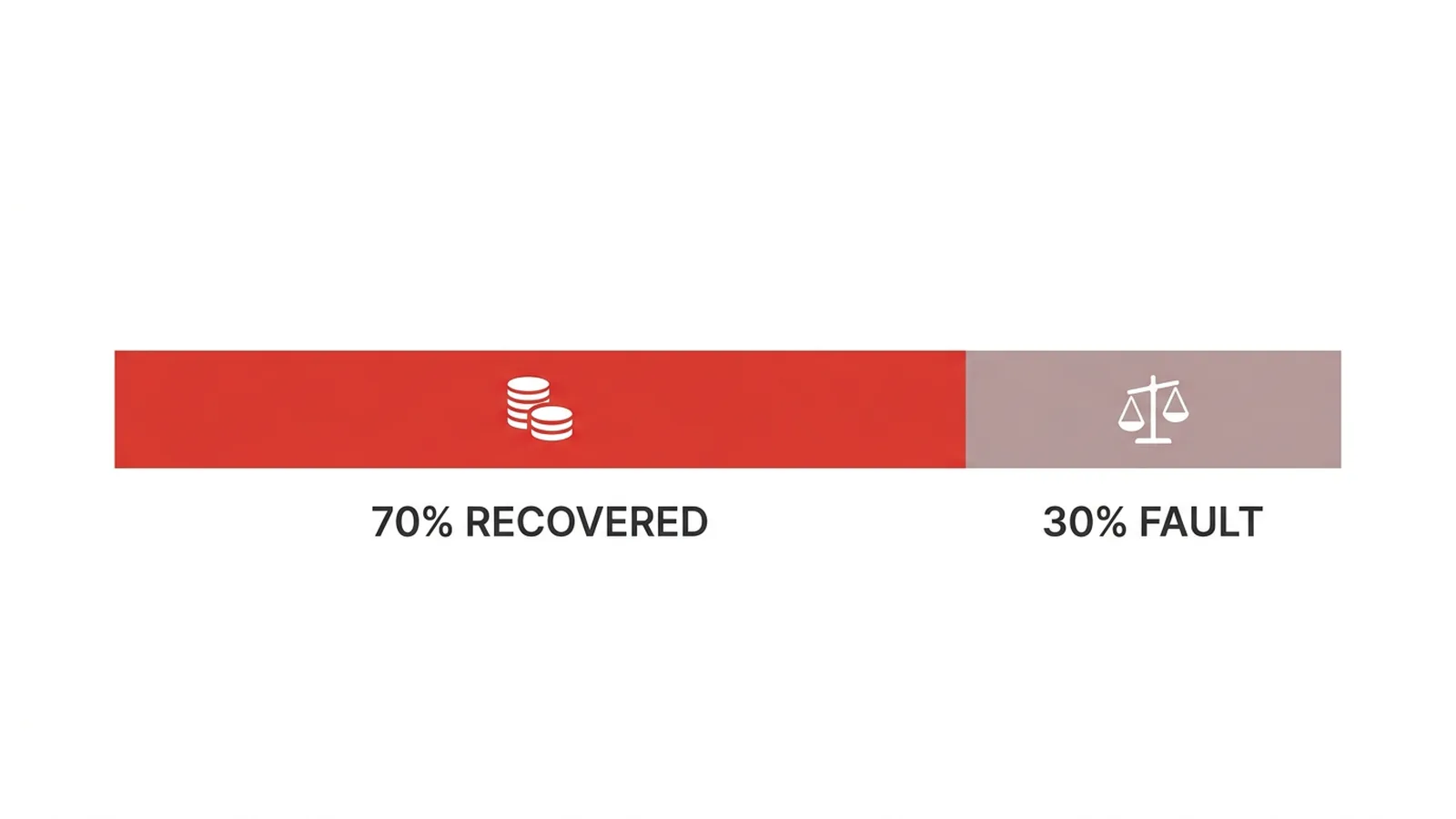
Say a jury finds you 30% at fault and returns a verdict of $100,000. You can still recover $70,000, because you were 70% not at fault. The same arithmetic holds as the numbers grow. On a million-dollar verdict at 30% fault, you recover $700,000. On a ten-million-dollar verdict, seven million.
The part that surprises people is that there's no cutoff. A lot of people assume that once they're more than half at fault, they're out. Not in California. Even if you're found 70% at fault, you can recover 30% of the verdict. A case where the other driver carries less than half the fault can still be worth pursuing when the injuries are serious, because 30% of a large number is still a large number.
Fault still matters. Every point of it comes off the top. The useful question is how much fault there is and what it does to the value.
A fault percentage in an offer is a negotiating position
Cases are often described as "disputed liability," and often it isn't a real dispute. The insurance company simply announces that it's putting my client at 50% fault. When we know my client was not at fault at all, my answer is that we're not accepting the reduction. A percentage written into a letter is the other side's opening position, and it doesn't become a fact because it appears on the letterhead.
It helps to understand why the number shows up. Insurance companies value claims, and the valuation has inputs. Picture a claim their own spreadsheet says is worth $100,000. If they can put 20% of the fault on you, and argue that a gap in your treatment was a problem, that $100,000 starts sliding toward $50,000, and the first offer may land closer to $20,000 in the hope that you'll take it and move on. The fault percentage is one of the levers.
In a serious injury case the lever gets heavier. Take a brain injury claim valued at a million dollars. If the insurance company holds you at 60% at fault, it can say it agrees the claim is worth a million and still only offers $400,000. In a ten-million-dollar case, twenty points of fault is two million dollars.
I've sat on the other side of this. When I was doing civil litigation and we were trying to limit what a client paid, the approach was always to paint a picture that the injured person was at least partly at fault, even when it was fairly clear they weren't. That approach is how the defense side of a case is built, whichever company is paying.
The answer is the story. Our job is to explain what happened clearly enough that a jury, and before that an adjuster, understands this was not a 50/50 case. If my client had a green light, the evidence has to show a green light, so the fault lands where it belongs: 100%, or maybe 90%, on the other driver.
But the key is they wanna shift blame onto you so that they can cut the payout. And every piece of percentage, especially in a brain injury case, when we're talking about a very high-value case, is a significant savings.
Helmets and lane splitting on a motorcycle claim
Motorcycle riders walk into a claim with a set of assumptions already working against them, and fault is where those assumptions get turned into numbers.
Riding without a helmet does not end a motorcycle claim in California. What the insurance company can do, if you suffered a head injury, is argue that a helmet would have prevented it or made it less severe. If your injuries would normally be valued at one level, they'll use the missing helmet to try to pull that value down. That's an argument about value. It's not a bar to recovery.
Lane splitting gets the same treatment. An adjuster may tell a rider that splitting lanes means they were negligent and dangerous. That isn't the law in California. Splitting lanes is not, by itself, negligence.
Part of the problem is that adjusters aren't always familiar with the law, and aren't always acting in good faith. I've had adjusters misstate the law to me directly, and when I correct them, they tell me I'm wrong. My response is to ask them to put it in a letter so I can respond to it in writing. A rider who hears the same thing over the phone after a crash has no way to push back. They hear that they weren't wearing a helmet and the insurance company can't do anything for them, and they assume that's the end of it.
That's the reason I'd rather a rider talk to a lawyer early. Nobody can go back and undo a decision made on a misstatement of the law. Motorcycle cases carry prejudices a lot of people don't notice they hold, which makes it that much more important to have a motorcycle accident attorney who knows where the rider was in the wrong, where they weren't, and how each piece affects the case.
A prior injury that flares after a crash
A common version goes like this. Someone comes in and says they had a back injury from work ten years ago, their back has been bothering them since the crash, and they figure they're out of luck because they were already injured. That's not the case, at least not in California.
What we do is look at the prior medical record. Say the work injury was ten years ago. They were treated, maybe they even had surgery. Then for the last five years there was no treatment at all. The record shows the injury had gone quiet. After the crash, their pain shoots back up and stays up. The claim is for the difference between where they were before the crash and where the crash left them, and the earlier records are what prove the "before."
The insurance company will try the opposite framing: this person always had problems, there was always something wrong with them, and they're no worse now than they were before. Whether that argument works depends on the records. A treatment history that shows a quiet period, followed by a crash, followed by documented, persistent symptoms, is hard to explain any other way.
The eggshell plaintiff rule
The same principle has a name when the earlier injury is serious. A person made more vulnerable by an earlier injury is often called an eggshell plaintiff, after the eggshell skull doctrine. Put simply, someone who was hurt before can recover when a new injury hits the old one and makes it worse.
Brain injuries show it most clearly. Picture someone who had a substantial head injury in their 20s and was already living with some deficits from it. They couldn't work as a doctor or a lawyer anymore, but they could hold down a job, walk, talk and get through the day. Then at 41 they're in a car accident and suffer a second brain injury. Now they can't hold down any job, and some days the migraines leave them in bed all day.
We can recover for that gap between where they were after the first injury and where they are after the second. Handled properly, the earlier injury can make the case significantly more valuable than it would have been otherwise, because the person was more susceptible and the harm is greater than it would have been for someone with no history.
It doesn't take a dramatic first injury for this to matter. Even a mild concussion on a soccer field, the kind someone walks away from, can make a person far more susceptible to lasting effects from a later blow to the head.
This only works when two things are true. The new injury has to be documented early, so there's no gap for the other side to fill with a different explanation. And the person telling the story has to understand the medicine well enough to explain it plainly to an insurance company and, if needed, a jury.
Common Questions
- Can I still recover if I was partly at fault for an accident in California?
- Yes. California reduces your recovery by your share of the fault, and there's no cutoff. If a jury finds you 30% at fault on a $100,000 verdict, you can recover $70,000. The rule holds at the high end too: "Even if you're found 70% at fault, you can recover 30%" of the verdict. Fault lowers the value of a claim without erasing it, which is why a serious injury can be worth pursuing even when you share the blame.
- Does riding without a helmet ruin a motorcycle accident claim in California?
- No. In my words from the show, "actually in California, riding without a helmet does not wreck your claim." If you suffered a head injury, the insurance company can argue a helmet would have prevented it or made it less severe, and use that to push the value down. That goes to how much the claim is worth, not whether you can bring it. Lane splitting is not, by itself, negligence either.
- Can I get compensation if I had a back injury before the accident?
- Yes, for the difference between your condition before the crash and after it. We look at your prior records. If an old injury had gone quiet and the crash brought it back, that change is compensable. As I described the typical case, "Now they get into the subsequent accident, their pain levels shoot back up, and it's not getting better." Records showing the quiet period before the crash are what make that difference provable.
- What is the eggshell plaintiff rule?
- It's the principle that someone made more vulnerable by an earlier injury can recover when a new injury makes their condition worse. As I explained in the brain injury episode, "They're typically known as an eggshell plaintiff or the eggshell skull doctrine." A person with a prior head injury who suffers a second one can recover for how much worse the second made things, and that history can make the claim more valuable rather than less.
Chapter Reflection
Fault and history are the two places where an injured person is most likely to talk themselves out of a claim before anyone has looked at it. In both, the argument against them is real, it gets made early, and it sounds final when an adjuster delivers it. It rarely is. A percentage is a position until evidence settles it, and an old injury is a baseline until records show what the crash changed. The cases that come out well are the ones where someone did the work of proving where the line between before and after falls.