
Uber and Lyft Accidents: Coverage Periods and the $1 Million Policy
Rideshare crashes look simple from the back seat. You were in somebody else's car, the company behind the app is enormous, and surely somebody's insurance is going to take care of it. In practice, a rideshare case is often more complicated than a standard auto accident case, and sometimes a lot more complicated. There are layers to the insurance, and whether any given layer applies depends on facts the injured person usually can't see.
The biggest of those facts is the driver's app status when the cars collided. Whether there was a passenger in the car, whether the driver was on the way to a pickup, or whether the driver was just circling with the app on, waiting for the next request, decides how much coverage is there. On top of that sit the questions of whose policy applies when more than one driver caused the crash, what happens when the injured person is the rideshare driver, and what to do when the company calls early with a check. This chapter takes those one at a time, whether you were the passenger, the driver, or a pedestrian or another motorist hit by a rideshare car.
I think we as the public assume that all these cars are on the road and we're all well-protected 'cause they're all rolling around with a million dollars of coverage. That's unfortunately not the case.
The stage the driver was in decides the coverage
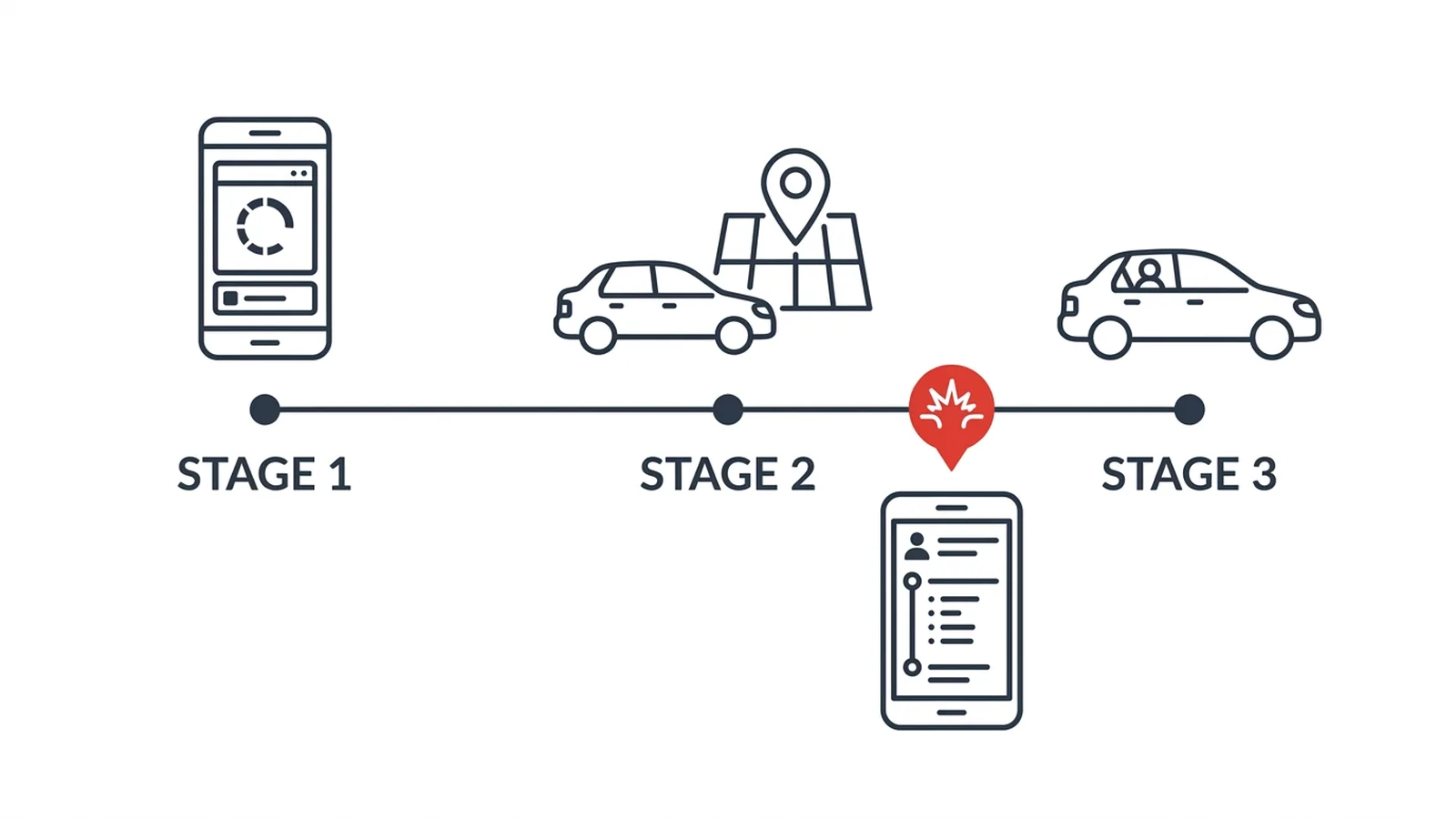
Rideshare insurance in California works in stages. We refer to them as tiers, stages or periods, and the stage is tied to where the driver and the vehicle were in the course of a ride. Stage one is a driver with the app on, driving around and waiting for a ride. Stage two is a driver on the way to pick someone up. Stage three is a driver with a passenger physically in the vehicle. Stages two and three carry the same million-dollar requirement, and a driver circling the block waiting for a request has much, much lower coverage.
That is why the stage is so often disputed. The difference in coverage between stages can be the difference between a modest policy and a million dollars, and placing the crash in a lower stage saves money, so expect it to be argued. The injured person rarely has the information to push back. Most people have a very hard time working out which period applied, what the insurance limits are, and what those limits mean for them.
The answer is in the data. The rideshare company's own app data and GPS data show what the driver was doing at the moment of the crash, whether a ride had been accepted, and whether a passenger was in the car. When we're involved early, we can pull that app data and see the stage for ourselves rather than taking anyone's word for it. That is one of the first things I want secured in any rideshare case.
When you are the passenger
If you are riding in an Uber or a Lyft and the car crashes, you're typically in period three, and that is the best position to be in. The law requires a million dollars in coverage from the moment the driver accepts the ride. The money to compensate for a serious injury is usually there. The fight is over whether it applies.
That fight shows up most when more than one driver is involved. I had a case where an Uber driver was drowsy and dozing off on the freeway. A crash happened ahead of him that he didn't cause, and if he had been alert, he probably could have slowed down and avoided it. Instead, the dash cam showed him falling asleep before the impact, and he hit the stopped cars at full speed. We represented his passenger. Now there are multiple responsible parties, and the argument becomes whose insurance applies. The rideshare company's position will be that its driver isn't at fault and the drivers in the first crash are the ones whose policies should pay. A passenger left to sort that out alone can end up caught between insurers, each pointing at the other.
Injuries that happen getting in or out of the car can raise the same kind of argument. Say you're stepping out, the driver pulls away, and you get caught on the side mirror and dragged. Many people assume that because they were already out of the car, they have no claim. Those injuries can be covered under the rideshare company's policy. If you call the company or its insurer directly, you may hear right away that there's no coverage and that they're sorry this happened to you. Without someone willing to tell them they're wrong, the injured person is left in a pretty bad position.
Rideshare drivers and the limits of their own coverage
A lot of drivers think they're protected because they carry good coverage on their own car. Your own personal auto policy is almost never going to apply while you're driving for a rideshare company. There may be a small number of cases, maybe 1%, where a driver has a rideshare rider on their personal policy that the insurer knows about and has approved, but that is exceedingly rare. Personal policies typically exclude rideshare driving, often completely, and some insurers will try to get out of coverage even when the app was off, on the grounds that they never would have insured the car had they known it was being used for rideshare.
That leaves the driver depending on the rideshare company's coverage, and that coverage has limits drivers don't expect. We represented a driver who was called to a pickup that turned out to be a setup for a carjacking. Several people showed up with guns, shot him, and took his car. If you think about it from the criminal's side, it's easy carjacking: type in an address, wait somewhere dark, and the car is delivered to you. Our client survived, but he was shot in both legs. He could still walk, but he could never run again, and he was out of work for a year.
He assumed he would be covered under the rideshare company's uninsured and underinsured motorist coverage. The company's position was that the shooting didn't happen in the course of driving, so its insurance didn't cover it at all, and that he wasn't eligible for workers' compensation either, because he was an independent contractor. I believe the offer was somewhere around $1,000 or $2,000. This was a man who used to run every day. That case is a good example of how many layers sit between a rideshare driver and the coverage everyone assumes is there.
When a rideshare car with no passenger hits you
One of the bigger issues I come across in rideshare cases has no passenger in it at all: a rideshare driver with no one in the car who hits another vehicle or a pedestrian. Drivers in period one are moving around looking for the next ride, and many of them have two phones going, one for each app. That is a recipe for distraction, and when it ends in a crash, it is a traditional auto case on its facts but not on its insurance. The coverage in that period may be far lower than the million-dollar figure people have heard.
So the stage matters just as much here, and so does the data. If you're a pedestrian hit by a rideshare car, the company may say the driver had no passenger, because that limits the coverage. The driver may also have had a passenger and not reported it. Either way, the app data will often show whether the driver was engaged in a ride at the time, and if they were, the higher coverage applies. If they weren't, a different set of insurance rules applies.
There is other evidence that disappears just as fast. Black box data from the rideshare car, and sometimes from other cars involved, can show how fast everyone was going, whether the driver was paying attention, and whether they braked or steered. If the vehicle you were in was totaled, the insurance company or the rideshare company will want to dispose of it quickly, and once it's gone, nobody can inspect it. And where a driver's history should have kept them off the road, such as a record of seizures or a long pattern of speeding and running lights, that history can be the key to opening up the policies or going after the rideshare company directly. None of that can be used unless someone gets to it early.
The early check and what it can cost you
Sometimes the contact goes the other way. Instead of a denial, the rideshare company calls and says it wants to make sure you're fine. It offers a check, or offers to cover the next six months of medical bills, and all you have to do is sign. I understand why that is appealing. People who are hurt are nervous and scared, and the first worries are usually how the medical bills are going to get paid and how to cover the work they're missing. Money up front feels like relief.
I can assure you that that check is always a small fraction of what that case is actually worth. And that check is contingent upon that treatment stopping on a certain date. It is not an open-ended invitation for you to actually get better.
Early in a case, nobody knows what getting better will take. An injury that looks like it needs a few months of therapy may turn out to need surgery, and surgery may need rehab. Some surgeries need a second surgery, because surgeries don't always go as planned, and some people come out the other side with a permanent disability. If you have already signed and accepted that early check, we can be precluded from going after the true value of the claim, no matter what the next year of treatment reveals.
So the order I recommend is simple. Get medical treatment right away and see the specialists you need to see. Get representation quickly, because the app data, the GPS records, the black box and the vehicle itself all need to be secured early. And document the scene with photos if you can, even though right after a crash, especially if you hit your head, your thinking is not at its sharpest. Sign nothing until the injury is fully understood.
Common Questions
- Who pays if I am hurt as a passenger in an Uber or Lyft?
- Usually the rideshare company's policy. A passenger in the car is typically in period three, where there is usually a million dollars in liability coverage, so "if you're a passenger in an Uber, you're generally in pretty good shape." The fight tends to come when other drivers share fault, because the company may argue their insurance should pay instead.
- Does an Uber driver's personal car insurance cover a rideshare accident?
- Almost never. Personal auto policies typically exclude rideshare driving, and the exclusion runs the whole time the driver is on the app. There are rare exceptions, such as a rideshare rider the insurer has approved, but otherwise "Virtually always you're gonna be excluded." Some insurers contest coverage even with the app off, so drivers should not count on their own policy.
- What happens if a rideshare driver with no passenger hits me?
- Coverage depends on the period the driver was in, and a driver waiting for a ride carries far less than the million-dollar policy. In that situation the law requires $50,000 per person in primary coverage, with a $200,000 excess layer above it. The rideshare company's app data can show whether the driver had accepted a ride or had a passenger, which can change the coverage, so that data needs to be pulled early.
- Should I accept an early check from Uber or Lyft after a crash?
- Not before the full extent of your injury is clear. Early checks are often tied to treatment ending by a set date, and at that stage nobody knows whether you will need surgery, rehab or more. As I tell people, "It may require surgery for you to get better. That surgery might require rehab." Signing can prevent you from recovering the claim's full value later.
Chapter Reflection
Most people get into an Uber or a Lyft without a thought about insurance, and that is how it should be. The trouble starts after the crash, when the coverage everyone assumed was there turns out to depend on a stage, a timestamp, a phone screen, and whose story about them gets believed. Nothing about a rideshare case is beyond an injured person's understanding. It just doesn't explain itself. The data that settles the question exists, and it sits with the company. The person who asks for it first, and who doesn't sign anything before they know what their body needs, is the one whose case still has room to grow.