
What Your Injury Claim Is Worth: Economic and Non-Economic Damages
There's no such thing as an average settlement. I know that's not the answer people are hoping for, especially if they've heard what someone else's case settled for. Settlements run from fairly low numbers, where the impact was minor and the person recovered quickly, all the way up to millions and millions of dollars, where the injuries were catastrophic or long-term. Any average blends the small cases with the catastrophic ones, and the figure that comes out describes almost nobody.
What I can do is show you how a claim gets taken apart. My firm looks at every case, from the smallest to the biggest, and works out how to get that client the maximum recovery, because that's a personal injury attorney's job: to get the most money for our clients and make sure they're taken care of into the future. The easiest way to do that is to break the claim into pieces. What did the injury cost you in money? What did it cost you in the rest of your life? What has already happened, and what is still coming?
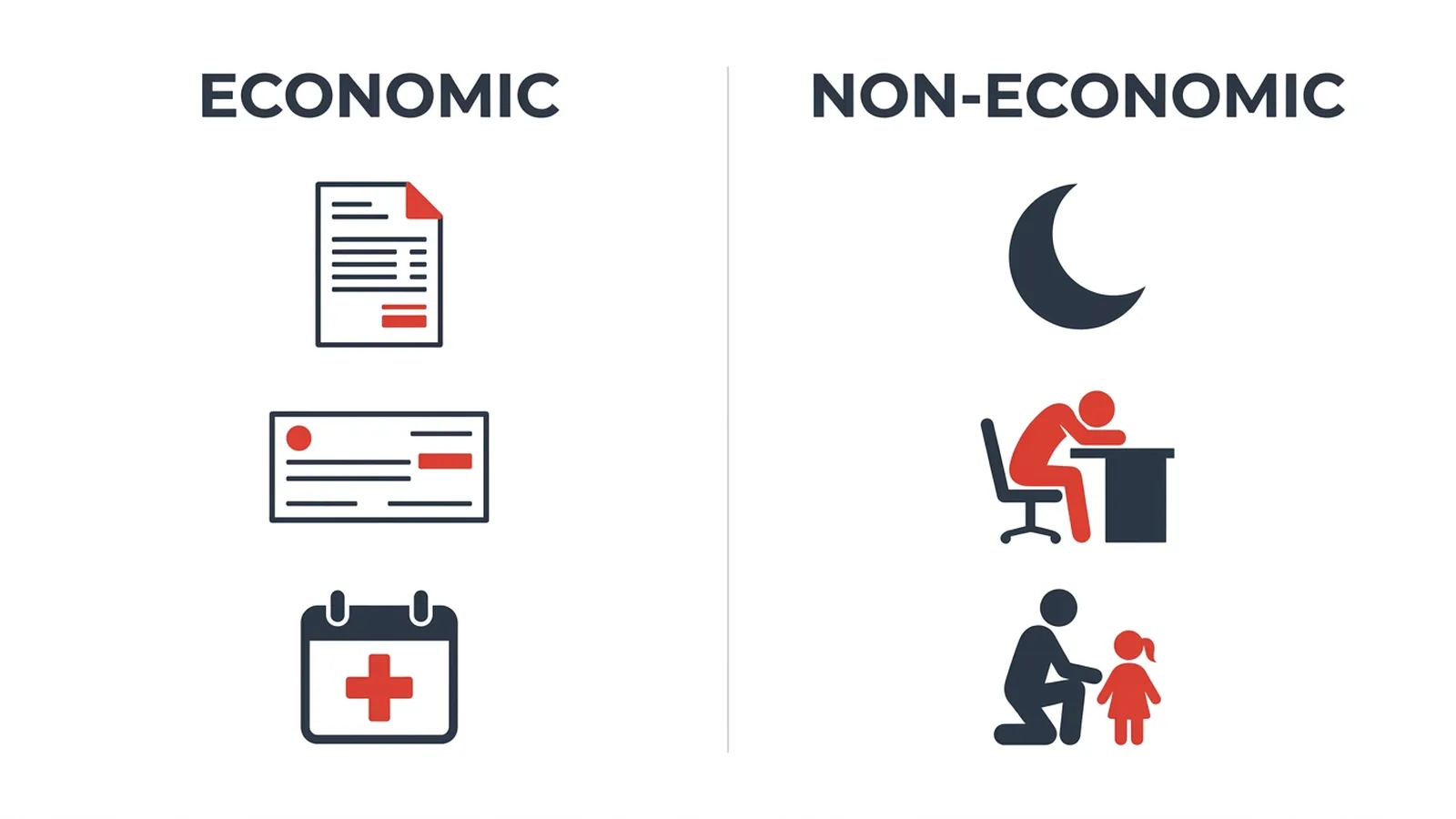
Economic damages: the losses with a receipt
Economic damages are the simpler half. They're medical bills, lost wages and future treatment costs. If you missed work for two months, that's an actual amount of money you lost out on. If you paid for something out of your own pocket because of the injury, that's money too. These are the losses that can be documented easily: we look at what the medical bills were, and then we extrapolate what the care is going to cost in the future.
Even the bills aren't always counted the way people assume. One way is to count only what the doctors actually accepted as payment. Another is lien treatment. When the injuries are severe, people often can't afford the medical expenses up front, so there are other options for treatment that let them get the care they need, with the provider paid out of the case. Which approach fits depends on how a person was treated, and it's something a lawyer should walk you through early.
Economic damages matter, and they're the part of the claim people understand best. In a serious case, they're often not the part that weighs heaviest.
Non-economic damages: what the injury took from your life
Non-economic damages are much more difficult to categorize. They answer one question: how has this accident changed your life? Sometimes the answer sounds simple. You don't sleep as well because you're in pain all the time, so you're tired at work, so you have trouble focusing at work. Sometimes it's bigger. Someone with a significant spine injury may have young kids they're used to wrestling with and throwing around. That's one of the ways parents and kids bond, and when the injury takes it away, that's a significant loss we need to compensate for.
With a traumatic brain injury, it can look like this: a person looks fine walking down the street, and relatives think they're fine unless they have an extended conversation, but they can't concentrate at work and constantly make mistakes. Then think about what that does to a person's self-worth. For a lot of people, the ten or twenty or thirty thousand dollars they lost in wages weighs less than how the injury is going to affect them for the rest of their life.
These are the harder things to put numbers on, and they're the part injured people often don't expect to matter. People ask me, if they're paying my medical bills, what's the big deal?
A perfect example is someone who's paralyzed, right? Their medical bills may have gotten paid, but their life has been forever changed. All the things they like to do, they can no longer do.
Past losses and future losses
Both kinds of damages get divided a second time, by time. Past damages run from the date of the accident up to settlement or trial. Future damages ask how we compensate for what the injury will keep costing going forward.
The future half is where a life gets measured. Take someone who is twenty years old and has been out of work for two years with a brain injury. If they won't be able to work for the next fifty-plus years either, we have to value those fifty years. Or take a surgeon who had a twenty-year, high-earning career ahead of him and can't practice anymore. We have to compensate for the loss of those earnings, and for the cognitive and emotional changes that came with the injury. Cases like that are where expert witnesses and life care plans come in. Chapter 11 goes deeper into how that work is done.
The future half is also the part that's easiest to lose by moving too fast. A lot of people just want to get the claim over with. If you settle early, before anyone has the full medical picture, nobody truly knows what the claim is worth. You may not realize you'll need surgery in a year because of what happened in this crash. You thought you'd be fine, and six months later it's still hurting.
What moves the number
Property damage plays a part. Someone bumped in a Starbucks drive-through by a driver who wasn't paying attention and let his foot off the brake has a claim worth significantly less than someone in a major T-bone at 70 miles an hour, where the car is turned inside out and you're surprised anyone walked away from it. More important than the property damage, though, is the treatment.
Take two cases with equal property damage, both moderate T-bones. One person goes to a chiropractor for a month or two and reports being completely better. The other does the same thing but isn't getting better, sees a specialist, does the additional treatment the specialist recommends, and still isn't getting better. The second claim is worth more, for two reasons: that person needed a lot more treatment, and we know their pain continued. More pain over more time is more pain and suffering, which means a more injured person and a more valuable claim.
Back and neck injuries show how wide the spread can be. If someone needs a significant spine surgery, say a multi-level fusion, that case is going to be worth substantially more, potentially seven figures, than a case where someone treats with a chiropractor for two weeks and reports pain at a two or three out of ten. That second case is not going to have a lot of value. What separates the two is the imaging, the treatment the person needs and how they recover.
You may have heard there's a formula. Twenty, twenty-five, thirty years ago, adjusters commonly took the medical bills and multiplied them by three. If someone went to a chiropractor and had $5,000 in medical bills, the offer would come in around $15,000. Over time, insurance companies found that if they offered less, some people would take it, and some attorneys would too. So offers have gotten lower and lower, even though medical costs have gone up and up. An insurance company is a business, and its offers follow what gets accepted. No multiplier can value your claim. Someone has to show, through the records, what the injury did to your life.
Early ballpark numbers are a warning sign
A lot of times clients come in and tell me another office said they could get a certain amount, or an attorney they talked to already thinks the case is worth a specific figure.
Frankly, anyone that tells you that, you should probably run. They don't know how to properly value a claim if they're giving you ballpark numbers straight off the bat.
Here's why I'm that blunt about it. A low back injury that turns out to need surgery is worth drastically more than a low back injury that goes away with some light physical therapy, and on day one nobody knows which of those you have. There is no specific valuation early in a case, and there's no real early timeline. Once a certain amount of treatment has happened, we can look at the case as a whole and give you an idea or a range. Doing that on day one would be shortsighted, and we explain to clients why we won't.
When we do value a case, it isn't one person's hunch. Our whole office looks at the case and we come up with our own range, our own valuation. It may be modified over time, because cases get worse and cases get better, and when it moves we can explain why. That explanation is what you should expect from any firm. A number with no reasoning behind it is a guess.
The same caution applies to an early offer from the other side. An insurance company may offer to pay all your medical bills if you settle today, three months in or six months in. The point of an offer like that is to close the claim before anyone knows whether the injury is permanent. In a brain injury case especially, you never want to accept a number without talking to an attorney, because an early figure typically doesn't account for any future treatment.
Common Questions
- What is the average car accident settlement in California?
- There isn't a meaningful one. Settlements range from low numbers for minor impacts where the person recovers quickly to millions of dollars for catastrophic injuries, and an average mixes all of them together. On the podcast I put it this way: "So when we're talking about averages, I mean, every figure's blending these small cases with these catastrophic crashes." Your claim's value turns on your injuries and your documentation.
- What is the difference between economic and non-economic damages?
- Economic damages are the losses with a dollar figure attached: medical bills, lost wages, out-of-pocket costs and future treatment. Non-economic damages cover how the injury changed your life, such as pain, lost sleep, trouble focusing at work, or no longer being able to play with your kids. In serious cases, the non-economic side is often the larger part of the claim, and it's the part that needs the most careful documentation.
- Do insurance companies still multiply medical bills by three?
- Not the way they used to. Meds times three was a common approach decades ago, and offers have dropped since then even as medical costs have climbed. In my words: "It used to be 20, 25, 30 years ago, they would take the medicals, multiply them by three, and that would be the number." Today a claim's value has to be shown through the medical records and how the injury affected the person.
- Why can't a lawyer tell me what my case is worth at the first meeting?
- Because the value depends on facts nobody has yet. A back injury that ends in surgery is worth far more than one that resolves with light physical therapy, and on day one there's no way to know which one you have. After some treatment, a firm can give you an idea or a range and explain the reasoning. A ballpark figure on the first call is a guess, not a valuation.
- Does more property damage mean a bigger settlement?
- It affects value, but less than most people think. A drive-through bump and a high-speed T-bone will be valued differently. Between two crashes with similar damage, though, the treatment decides more: the person who needs a specialist and keeps reporting pain has a more valuable claim than the person who gets completely better after a month of chiropractic care.
Chapter Reflection
A claim's value isn't something you look up. It gets built, one record at a time, out of what the injury has cost you so far and what it will keep costing, in money and in the parts of your life that money only stands in for. That's the reason I won't hand anyone a number on day one, and it's the reason the next chapter matters as much as it does. Every piece of value in this chapter has to be proven, and the place it gets proven, or lost, is the medical record.