
Traumatic Brain Injury: Proving an Injury That Does Not Show Up on a Scan
A traumatic brain injury is often called an invisible injury, and the person who has one is often the last to see it. Someone walks away from a crash talking, gets a CT scan in the emergency room, hears that the scan is clean, and goes home. Two weeks later they can't sleep, they're getting angry all the time, they can't focus at work and light bothers them, and nobody has connected any of it to the crash.
This chapter explains what a traumatic brain injury is, why the imaging so often comes back normal, and how a brain injury gets proven anyway. The short version is that these injuries are diagnosed from symptoms, and a claim is built from symptoms that were written down early and written down consistently. If someone in your family was in a crash and hasn't seemed like themselves since, this chapter is for you as much as for them, because the people closest to an injured person often notice the change before anyone else does.
Because oftentimes people think of their head and think, 'Well, I'm having headaches because my neck hurts,' or, 'I'm not sleeping good because my neck hurts,' or, 'I'm losing track of things because I'm distracted by the pain.' But they're not realizing that they may actually have a head injury even though their CT scan came back fine, and we've seen this countless times over the years that we've been doing this.
Defining a traumatic brain injury
A traumatic brain injury is damage to the brain from any outside force. Doctors grade them mild, moderate and severe. A concussion, the word emergency rooms use most often, is a mild traumatic brain injury, sometimes written mTBI. Mild describes how the injury is classified. It does not describe what the injury can do to someone's life, and a concussion can leave serious, lasting injuries behind.
The head does not have to hit anything. A whiplash motion is often enough, what's known as a coup contrecoup motion. The brain bounces around inside the skull, the inside of the skull is rough, and the brain picks up tiny shears where it moves against it. The technical name for that shearing is diffuse axonal injury. Further up the scale are cerebral contusions, which are bruises on the brain, and subdural hematomas, which are brain bleeds. Those sit at the moderate to severe end.
A lot of people assume that if they weren't knocked out, they don't have a real injury. Much of what we now know about that comes from military research on soldiers who had spent time around blasts, Special Forces teams breaching doors week after week. Many of them may never have lost consciousness, and the repeated blasts still did damage. The same research explains why an earlier head injury matters. Once you've had one or two hits, you're much more susceptible to the next. Someone who had a concussion as a kid, or who took a lot of headers playing soccer, can be thirty years old in a car accident with a bad whiplash, never hit their head, and still end up with a traumatic brain injury.
Vehicle crashes are where I see these injuries most. High-speed, multi-lane freeways like San Diego's I-5, the I-8 and the I-15, and the Los Angeles freeways produce crashes with multiple impacts and cars that spin, and the head can be injured without ever striking anything. Motorcycle, pedestrian, bicycle and rideshare cases cause them too, and so do falls, when someone's legs go out from under them and they land on the back of their head. The greater the force, the more likely the harm is long term, but I see brain injuries from crashes with little visible property damage as well.
In the ER, doctors score a head injury on the Glasgow Coma Scale, the GCS, based on eye, verbal and motor responses. It's a limited tool, designed to answer one question: is this person at risk of dying right now? A patient with a mild traumatic brain injury and no brain bleed passes that test. Passing it is a different thing from not being injured.
A clean scan is not the end of the question
A CT scan is an ER tool. It's designed to find an active brain bleed or a skull fracture, the severe injuries that get handled urgently. If neither is there, the hospital sends you home and tells you to follow up, and that's true even if you were knocked unconscious, as long as you're awake, alert and cognizant by the time they're done.
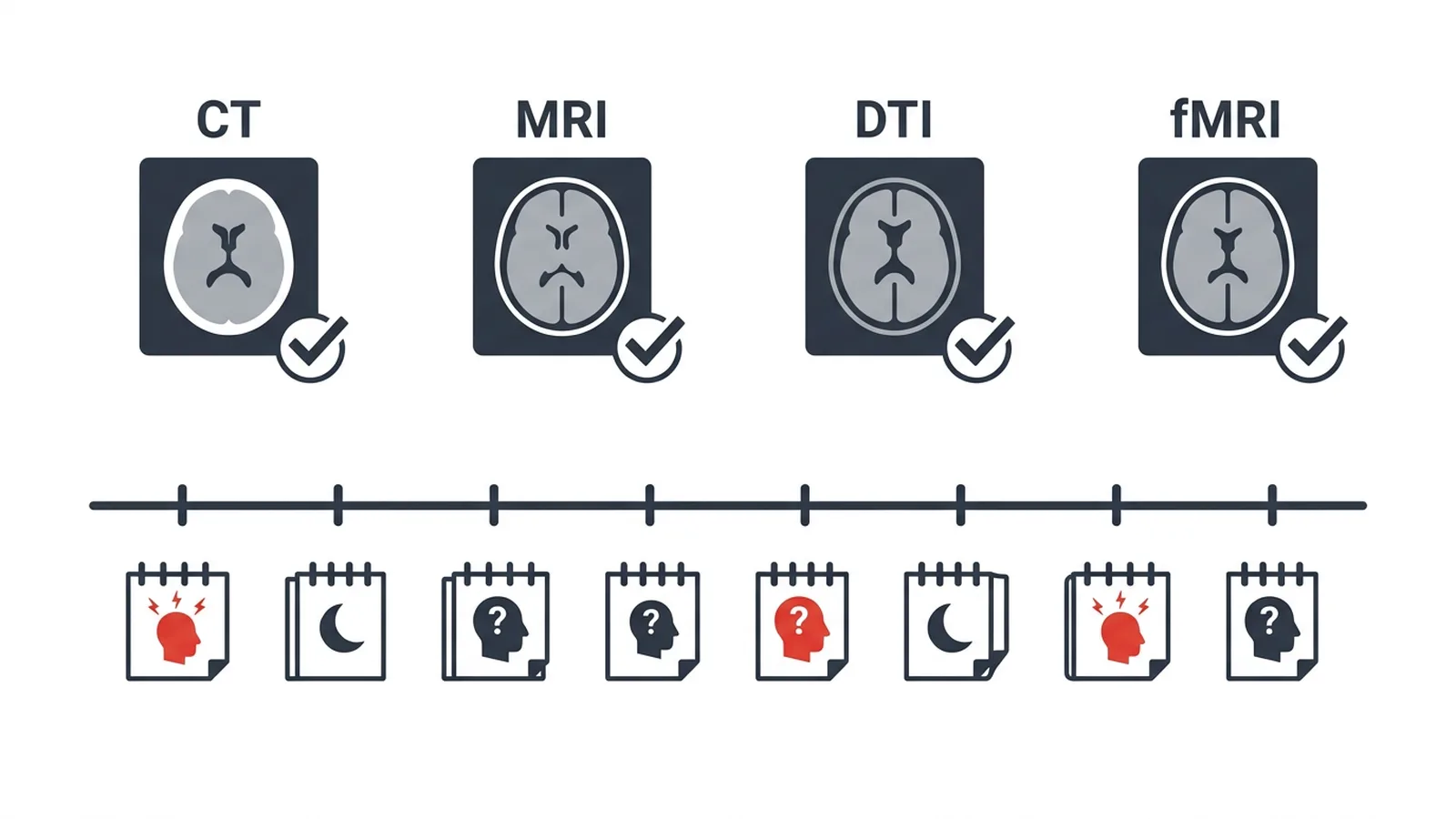
Beyond the CT there is a ladder of advanced imaging, generally in this order: an MRI, a DTI, and then a functional MRI, or fMRI. The fMRI and the DTI are the advanced scans most likely to show a brain injury. On a DTI, a healthy brain lights up everywhere, and a traumatic brain injury can show up as dead zones, areas that don't light up the way the rest of the brain does. That's the best case for proof, and it doesn't always happen. A person can have a CT, an MRI, a DTI and an fMRI that all come back clean.
That is where a lot of people stop, and some lawyers too, and it shouldn't be. Mild brain injuries are diagnosed from symptoms; scans often look normal. If we know there was an impact to the head, or a significant whiplash, and the person reports symptoms consistently over time, a diagnosis of traumatic brain injury can be made with no imaging that shows it at all.
Here is what consistent looks like. At the ER, the person complains of headaches and forgetfulness, maybe feeling sleepy but being unable to sleep. Two weeks later they report the same symptoms plus a few new ones. A month later some are the same and some are different. Over the course of a year, the same symptoms keep showing up visit after visit. That pattern can prove the injury even when every scan is clean.
When imaging does show something and the symptoms have been reported accurately, that's the gold standard. A neurologist can look at both and say the injury was caused by the crash. If your crash happened in San Diego, the trauma centers there, Scripps, UC San Diego, Sharp and Rady Children's, will all have records of that first visit, which is one more reason the first visit matters.
The symptoms people overlook
The symptoms of a mild traumatic brain injury are a laundry list, usually grouped under the name post-concussion syndrome, or PCS: headaches, brain fog, irritability, exhaustion, sleep problems, and a loss of taste or smell that has nothing to do with COVID. This is the area many attorneys miss, because many attorneys are not familiar with the medicine, and because clients don't know which of their symptoms count.
Word-finding is the symptom I watch for when I'm talking with someone. The person knows exactly what they want to say. They're describing a day at the beach and dinner afterward, and they stall: "we went to the, we went to the," and the word beach won't come. It isn't a blank. They can't reach the right word, and you can watch them cycling through trying to find it. Plenty of people have this problem and don't know it has a name, word-finding difficulty, so it never reaches their doctor.
Many of these changes are noticed first by someone else. People with brain injuries often do things differently without being aware of it, and a spouse or a child sees it. That's why the symptom checklist my office gives to clients also goes to their significant others. The person living with the injured person is often the one who can describe what changed.
The other reason these symptoms go unrecorded is that something else hurts more. At the ER, a person's neck is hurting, they want to be sure they're not paralyzed, and their head never gets mentioned. Later, they put the poor sleep, the dizziness or the confusion down to the pain in their back or their leg.
So the instruction applies at every appointment: tell the doctor about everything. The ER doctor is focused on making sure you aren't dying and on getting you out of the ER. It's up to you to say that your head has hurt since the crash two hours ago, that you feel foggy, that you've been forgetful since the crash three days ago. Then follow up with your primary care doctor. If you don't have one, call your health insurance company, not your auto insurer, and ask which in-network doctors can see you quickly. If nobody can, go to urgent care. Do whatever it takes to get it documented.
A word on recovery, because people deserve the straight version. Cognitive rehabilitative therapy and neuro rehab programs, including one in San Diego, can help a great deal with how people learn to cope, and the brain can develop new neural pathways. But coping is not the same as healing. A brain injury can't be fixed with surgery, and symptoms that are still going on years later are likely permanent. When someone has to learn to live with a symptom, they deserve compensation for what was taken from them: a brain that used to work fine. Chapter 11 covers how that loss is valued.
Neurologists, neuropsychological testing and maximum medical improvement
Almost everyone starts with an ER physician or a primary care doctor. Primary care doctors have broad general knowledge, but not a specialist's depth, so as the symptoms continue, they eventually refer the patient to a neurologist, a specialist in the brain. The neurologist takes over the treatment, is better placed to prescribe medication that might help, and documents the injury with more precision.
The neurologist also helps identify what's called MMI, maximum medical improvement. If someone is two years past the crash, has improved slightly and still has symptoms, a neurologist can say that this is the maximum improvement, and that we now know what the injury looks like long term. If the case goes to trial, a neurologist can be a persuasive expert witness, because they can tell a jury that they treat this condition and have the education to explain what they see.
Neuropsychological testing, which most people shorten to neuropsych testing, is a set of tasks that measure memory, attention and processing. It's a way of documenting measurable deficits. The candid reason we often need it is that the defense uses it. Defense experts like neuropsych testing because they can use the results to argue that you're normal, so we will often get our own neuropsychologist, so there's an expert to offset their expert.
The center of how I prove a brain injury is the medical record, more than any test. What do your records show? What are the symptoms over time, and are they consistently reported? What does the imaging show, and what was the force of the impact?
Building causation, from the scene to the coworker
Every injury case has to show causation, also called proximate cause: that, more likely than not, the crash caused the injury. With a brain injury, I build that from the start of the timeline forward. Was there a traffic collision report? Were photos taken at the scene? Was an ambulance called? Did the person go to the ER right after the crash, or days or weeks later? And when they got there, what did they report: headaches, forgetfulness, trouble finding the right word, or only that their neck or back hurt?
Physical evidence helps when it exists, a photo of a bruise on the client's head, or video from inside the car showing the head striking something. When the head didn't strike anything, a decent impact and a significant whiplash can still carry the causation story.
After that, I look at how the injury is affecting the person over time, which means talking to people. Family comes first. Coworkers and friends matter just as much, for a specific reason: they have no vested interest in the outcome. An insurance company can argue that a family member is financially motivated, but a coworker isn't, and if anything the coworker is the one picking up the slack. Coworkers are often the first to notice the forgetfulness and the deficits. Later, when experts read their deposition testimony and see that the problems continued at work and at home, the case becomes much more persuasive.
The first month is where the defense looks hardest for gaps. If the ER doctor says go home and wait, and that's what you do for two months, you'll have a hard time later claiming the brain injury. If you follow up with your primary care doctor instead, and say you were told to wait but this is affecting your life, the record tells a different story.
Two questions trip up people with a brain injury, and both are about memory. The first is how the crash happened. People say they were rear-ended, it was a huge impact, their head got rattled, and never say they hit their head, because they don't remember whether they did. The second comes from the insurance company: did you lose consciousness?
If you lose consciousness, you don't remember that you lost consciousness. You typically come to and you say, 'What happened?' You don't have a cognizant, like thought that, oh, I'm losing consciousness 'cause that's not the way your brain works. You just lose consciousness.
How those questions get answered, and whether they get answered at all, is something I want to know from the very first conversation.
Two cases show how this plays out. One client was a fairly new college graduate, about five years out, working for a large healthcare organization when she was in a serious crash. Her imaging didn't show any problem with her brain. Because she had good health insurance through work, she kept following up with her primary care doctor and kept saying the same things: she wasn't the same, she couldn't focus at work, screens hurt her eyes, she was forgetting things. Her supervisors noticed it too. She was referred to a neurologist, the neurologist ran testing rather than more imaging, and the testing showed significant deficits, many of them permanent. We were able to get her a very large settlement, and she's taken care of for the rest of her life.
The second is the client from Chapter 4, T-boned at around 60 to 65 miles per hour. Her ER CT scan and a later MRI showed little, but from the first visit on she kept reporting the head pain, dizziness, migraines, forgetting and trouble finding words, and her doctors diagnosed the brain injury before more advanced imaging eventually showed dead spots in her brain. The insurance company's early offers were well below its million-dollar policy. Within about two weeks of trial, the case resolved in a confidential settlement in the range of between $5 and $10 million. What made the difference was her documentation over time. Neither result predicts what any other case will bring. Each one turned on its own facts.
Common Questions
- Can you have a brain injury if your CT scan or MRI is normal?
- Yes. A mild traumatic brain injury is diagnosed from symptoms, and a CT is an ER tool built to find bleeding or a fracture. A standard MRI often shows nothing, and a person can have a CT, an MRI, a DTI and an fMRI that all come back clean. When the impact is documented and the same symptoms are reported consistently over months, that record can prove the injury without a scan.
- Is a concussion a traumatic brain injury?
- Yes. A concussion is a mild traumatic brain injury, and it's the label emergency rooms use most often. Brain injuries are graded mild, moderate and severe, and the word mild only describes the classification. A concussion can still cause serious, lasting injuries, and someone who has had concussions before, even as a child or from soccer, is more susceptible to a worse injury the next time.
- Do you have to hit your head to get a brain injury in a car accident?
- No. The head doesn't have to strike anything. A hard whiplash can bounce the brain against the rough inside of the skull and cause small shears in the tissue. I often see brain injuries in rear-end and T-bone cases with a big impact where the head never touched the car. What the claim needs is a decent impact and symptoms documented from the start.
- What symptoms should I report after a head injury?
- All of them, at every visit: headaches, brain fog, irritability, fatigue, sleep problems, sensitivity to light, forgetfulness, trouble finding words, emotional changes and any loss of taste or smell. The standing instruction my office gives is short: "When you're seeing doctors, make sure you're mentioning everything that's wrong with you." A record that lists one or two symptoms and leaves out the other ten is the record the other side will hold up.
- What is neuropsychological testing and why does it matter in a TBI case?
- It's a set of tasks that measure memory, attention and processing, used to document measurable deficits. It matters partly because the defense relies on it to argue that an injured person tests as normal, so my office often brings in its own neuropsychologist to answer theirs. In some cases, a neurologist's testing is what reveals permanent deficits that no scan ever showed.
Chapter Reflection
A brain injury case is rarely decided by a single test result. It's decided by a record: the ER note that mentions the headache, the follow-up visit that mentions it again, the coworker who noticed the forgetting, the neurologist who finally put a name to it. The injured person doesn't have to understand neurology for any of that. They have to keep saying what is wrong, every time, even after a scan has told them they're fine. Once that record exists, a family faces a different question, one that a clean CT never prepared them for: what a brain that no longer works the way it did is worth over the rest of a life.