
Valuing a Brain Injury Claim: Life Care Plans, Lost Earning Capacity and the Defense Exam
Once a brain injury is documented, the question every family asks next is what the case is worth. With a brain injury, the honest first answer is frustrating: nobody knows yet. Six months or a year after a crash is not enough time to know what symptoms a person will face in the future. They may improve, or they may get worse. A claim valued before that is clear is valued on half the information.
Here is how I build the value of a serious brain injury claim: why it can't be rushed, how lost earning capacity and the losses no bill captures are measured, and what a life care plan is. It also explains how the other side contests these claims, including the defense medical exam, so that none of it comes as a surprise when it arrives.
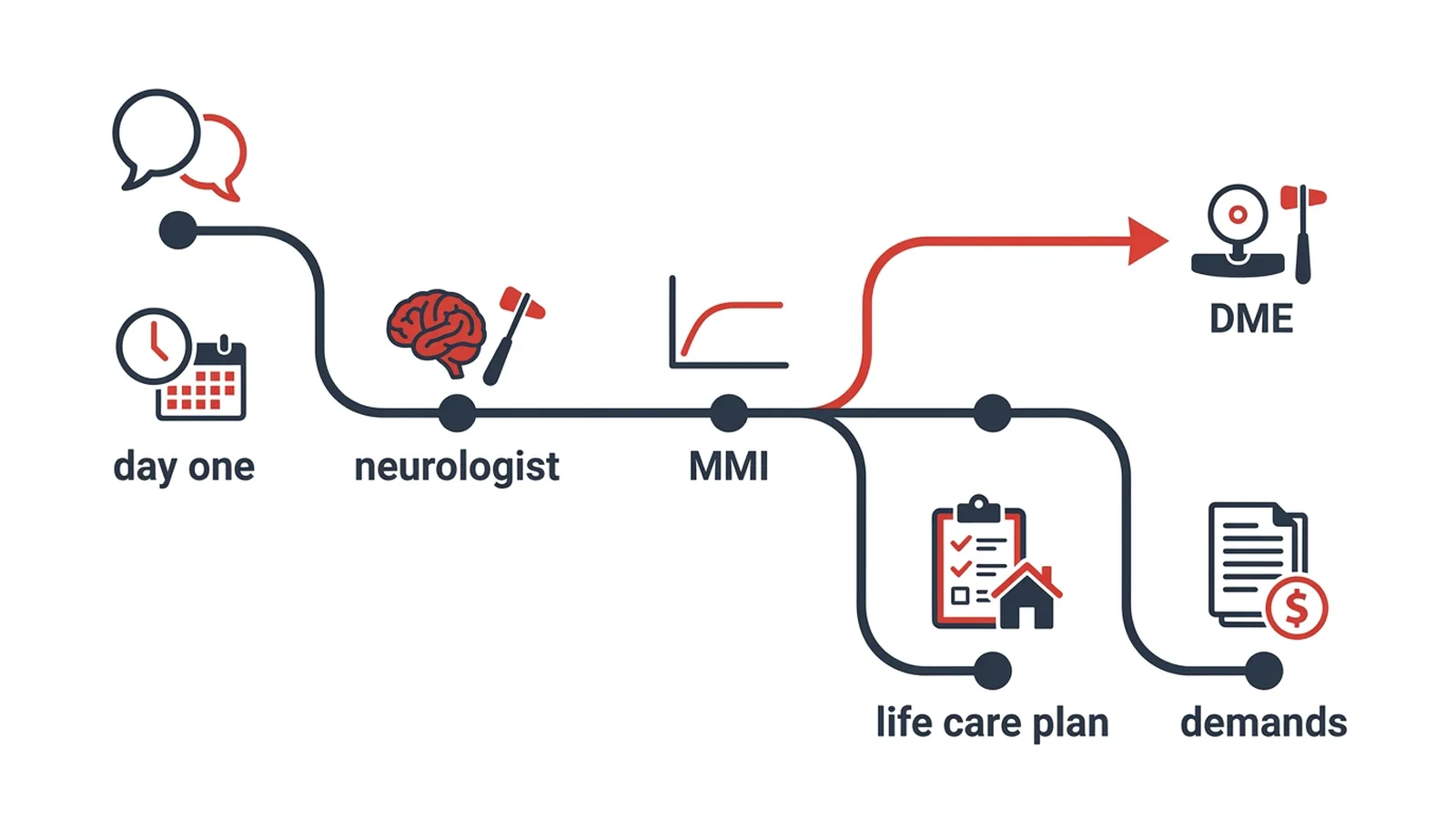
I tell every one of my clients that from the outset. I say minimum two years from the date of injury because we're not gonna have an idea of what's permanent and what's not until a year and a half, two years post-injury.
Why a brain injury case cannot be rushed
There are two reasons for that timeline. First, the injury has to be documented over time, because consistency is what proves it, as Chapter 10 explains. Second, we have to see what the person's permanent, long-term symptoms are and what the life care plan comes in at. Only then do we prepare demands, look at the insurance policy limits and whether they're going to apply, and add up the total medical bills, which can be huge when the claim includes a lifetime of future care and treatment.
The pressure runs the other way. Insurance companies are trained to offer money early, and in low amounts, because people will take it while they still think they're fine. Then the symptoms never get better, the person is never the same, and they want to go back and ask for more. By then the claim is settled, and that's where it ends.
A brain injury makes that trap more expensive than most, because someone who has had a brain injury is going to be susceptible to more cognitive decline in the future. An offer can sound good today. What does it look like in 10 years, or 15, or 20? What if dementia arrives years sooner than it would have, and the person needs help caring for themselves? That kind of care is extremely expensive, and a number offered in the first months of a case doesn't account for it.
Policy limits shape the timing too. When the at-fault driver has a very large policy, early offers tend to be low. When the policy is small, the insurer may want to pay the limit right away. Knowing which situation you're in matters, because if you're going to be injured for a long time, we don't want to run up $150,000 in medical bills and then find out there's only $50,000 in coverage. Chapter 4 covers policy limits in detail.
Lost earning capacity and the life care plan
Chapter 2 explains how damages divide into economic and non-economic, past and future. On a serious brain injury, the future is usually where most of the value sits.
Lost earning capacity is where future economic damages start. I look at the person's career up to the crash and then at their future earnings. Someone who was about to make partner had earning potential that would have gone substantially up over the next 20 or 30 years, and that may now be gone completely. The twenty-year-old with fifty-plus years of work ahead and the surgeon with a twenty-year, high-earning career, both from Chapter 2, are valued the same way. Valuing any of that takes expert witnesses, typically vocational rehabilitation specialists and life care planners.
A life care plan is the document that projects all of it forward. It's prepared by an expert, sometimes as a spreadsheet and sometimes closer to a bullet-point list, who can value earnings into the future as well as the past and can also look at the care the person is going to need. The planner reviews every doctor who has treated the client and every recommendation those doctors have made, then projects outward the treatment and therapy required. That might mean vocational rehab therapy for the next 20 years. For a young person with a significant brain injury, it also has to account for the likelihood of developing some level of dementia later in life.
The life care plan comes after the client reaches maximum medical improvement, or MMI, because that's when doctors can say what the person will need for the next 20 or 30 years. The planner assigns values to all of it and can sometimes account for the cost of medical treatment going up over time. In any serious brain injury case, we're going to have an extensive life care plan. Even in a very mild brain injury case, we'll sometimes prepare a smaller one where it's justified.
Non-economic losses: valuing what no bill shows
Economic damages are the hard numbers: lost wages, out-of-pocket expenses, medical bills. On a brain injury case they're often not what drives the value. Chapter 2 described the person who looks fine on the street and to their relatives but can't concentrate at work and keeps making mistakes. What weighs on that person is how this will affect them for the rest of their life, and what the mistakes do to their sense of their own worth.
I've handled a fair amount of brain injury cases, so I have a pretty good idea of what the range is, like where these different cases come in. But for your average person, it's very difficult to value non-economic damages because these are literally things that you would never trade money for to be taken away.
Think about what that looks like in a household. Migraines are so constant that the person has to sit in a dark room, and a relationship with a spouse and kids changes completely because of it. If someone offered you a briefcase full of money in exchange for chronic pain, dark rooms, depression, and either no work at all or work at a dramatically reduced capacity, you would know at once what the money was being asked to replace.
That is the loss a non-economic damages claim has to put a value on, and it's why the value rises with permanence. A person who had a mild concussion and recovered two months later has a claim with some value. A person whose life is permanently altered has a claim worth significantly more.
How the other side contests a brain injury claim
Before I represented injured people, I did civil litigation work on the other side of these cases, and part of that work was painting a picture that the injured person was at least partly at fault, sometimes even when it was relatively clear they weren't. So I know how the defense approaches a brain injury claim. None of it is personal. Each step is aimed at the same thing, a smaller payment, and each one has an answer.
Comparative fault is the first lever. In a high-value brain injury case, every percentage point is a significant saving to the insurer: if a case is worth $10 million and they can place 20% of the fault on you, they save $2 million. So expect fault to be argued even on a green light, and expect the answer to be a clear account of what happened that a jury can follow. Chapter 5 explains how comparative fault works in California.
Gaps and delays in treatment come next. If you didn't go to the ER right away, or waited weeks, your medical records will be scrutinized incredibly hard. They'll be read word for word, sometimes run through AI, for any discrepancy, and at trial a discrepancy gets repeated over and over. That's the reason to keep the record as clean as possible and continuous over time. When doctors have consistently documented the same symptoms and the same deficits, and those deficits aren't improving, it's very hard for anyone to argue that the scan was clean so the person is fine.
At trial, the defense will point to the ER sending you home and the MRI coming back clean, and will try to make the injury look unreal. They will also challenge the injured person's credibility and suggest they're embellishing. Anything that gives a jury a reason not to award money is something they will look for.
A prior head injury is the other common argument. The insurance company will say the person always had problems and is no worse now than before. Chapter 5 explains the eggshell plaintiff rule. With a brain injury it often helps the claim, because an earlier head injury makes a person more susceptible. Making that case well means understanding the medicine and explaining it clearly to a jury and to an insurance company.
The defense medical exam and how to prepare for it
At some point the defense will ask for an independent medical examination, an IME. Lawyers on both sides commonly call it a defense medical exam, or DME. The doctor is paid by the insurance company, and that doctor's role in the case is to look at you and find reasons you're not injured. Saying so accuses nobody. That is how the exam works, and clients need to walk in knowing it is not independent, with a lawyer already involved.
Knowing that doesn't mean fighting the doctor. Being adversarial or contentious is something the doctor can report, and it helps the other side. What I want from a client in that room is this:
- Be honest. Stick to the facts of what happened.
- Be consistent. Keep reporting the same symptoms you've been reporting all along.
- Be thorough. The doctor may ask about one or two things. Report every symptom you've had. If they suggest you had a little forgetfulness and that's about it, correct them: you also had word-finding problems, emotional difficulties, problems at work, problems with light, and your neck and low back have been bothering you too.
- Don't exaggerate. They test for that as well. Keep your answers short and concise.
You also don't walk in alone.
We're gonna bring a nurse observer with you who knows the medicine, knows what they're allowed to ask, what they're not allowed to ask. She's gonna record it. So the second they ask something that's improper, she's gonna shut it down.
The defense already has an advantage in that exam, because they chose and paid the doctor. A trained observer keeps that advantage from growing.
Common Questions
- How long does a traumatic brain injury case take?
- Expect a minimum of two years from the date of injury. Permanent symptoms can't be separated from temporary ones until about a year and a half to two years after the crash, and a brain injury claim can't be valued until they can. During that time the injury has to be documented consistently, the client needs to reach maximum medical improvement, and the life care plan has to be prepared before any demand goes out.
- How is lost earning capacity calculated after a brain injury?
- It starts with the person's career up to the crash and projects what they would have earned afterward. A person about to make partner, a surgeon with a twenty-year career ahead, and a twenty-year-old who won't be able to work for the next fifty years are each valued on that projection. Vocational rehabilitation experts and life care planners usually do this work, including how the costs of the injury play out over time.
- What is a life care plan in a TBI case?
- A life care plan is an expert's projection of the care, treatment and therapy a person will need for the rest of their life, along with lost earnings, past and future. The planner reviews every treating doctor's records and recommendations, then assigns values, sometimes including the rising cost of medical care. It's prepared after maximum medical improvement, and in any serious brain injury case, it's essential.
- What is an independent medical examination and how should I handle it?
- The insurance company picks and pays the doctor, so in practice it works as a defense medical exam. Don't argue with the doctor. Be honest, stay consistent with the symptoms you've reported before, report every symptom even if you're asked about only one, and don't exaggerate. Talk to a lawyer before you go. My office brings a nurse observer who records the exam.
- Should I accept an early settlement offer for a brain injury?
- Not without talking to an attorney first. As I put it on the podcast: "You never want to accept a number without talking to an attorney on a brain injury case because typically it's not gonna account for any future treatment." Six months or a year isn't enough time to know what symptoms you'll face. They may improve or worsen, and once a claim is settled, it can't be reopened when the symptoms don't go away.
Chapter Reflection
Valuing a brain injury is mostly an exercise in patience, and patience is a hard thing to ask of a family whose bills are arriving now. But a number is only as good as what it knows. A claim settled at six months knows about six months of symptoms. A claim valued after maximum medical improvement, with a life care plan behind it and a record that held up through a defense exam, knows about the next twenty or thirty years. The difference between those two numbers never appears on the settlement check, so a family that accepts the first one has no way of seeing what it left behind.