
Bicycle and Pedestrian Accidents: Right of Way and Fault on California Roads
People on bikes and people on foot share one thing that changes every part of their case: nothing stands between them and the car. They're sometimes called vulnerable road users. That isn't a legal term we use in California, but it describes the problem well. A cyclist or a pedestrian has no frame around them, and because they move much slower than traffic, drivers miss them in a way they rarely miss another car, or even a motorcycle flowing with traffic.
When a car hits someone on a bike or on foot, the first question is almost always who had the right to be where they were. That's where many injured people go wrong in their own heads. A cyclist assumes that because they didn't signal, they caused the crash. A pedestrian assumes that because they stepped off the curb a few feet from the crosswalk, it's their fault. Often, the law doesn't see it that way.
So a bicyclist is treated as a car for all intents and purposes under the law. So what that means is they have to follow the same laws that cars do. If they're coming to a stop sign or a stoplight, they have to stop.
A cyclist has the rights and duties of a driver
California law gives a person riding a bicycle on the road the same rights, and subjects them to the same rules, as the driver of a vehicle (California Vehicle Code section 21200). That cuts both ways. A cyclist has to stop at a stop sign or a red light like any car, and they're supposed to signal a turn, even though most of us have watched plenty of riders skip the arm signals.
Skipping a signal, or riding without a helmet, doesn't automatically put the cyclist at fault. There may be some comparative fault, but it's likely to be fairly minimal, because everyone operating a vehicle has a duty to be aware of what's going on around them. A driver doesn't get to watch the car in the next lane, ignore the bikes in the bike lane, make a left-hand turn, and then blame the cyclist they hit. Chapter 5 covers how shared fault reduces a recovery without ending it.
Passing is where a lot of drivers get careless. When a car passes a cyclist, the driver is supposed to leave three feet of space, under section 21760 of the Vehicle Code. Some drivers get annoyed and buzz the rider instead. That's a serious problem for the driver, because if a collision happens, they're likely to carry most or all of the fault, since they were in direct violation of the statute.
Lane markings add one more layer. A bike lane is the familiar painted lane at the edge of the road. A sharrow lane is newer: a regular traffic lane marked with large stenciled bikes, sometimes arrows, sometimes green paint, that tells drivers the lane is shared. You'll see them in high-traffic areas, a lot of beach cities among them. Picture two lanes heading north on Coast Highway 101 with the right lane marked as a sharrow. Cars and bikes both use it, and the cyclist gets more room. My understanding is that sharrows may be a little safer, because drivers seem more likely to treat a bike in a sharrow lane as a vehicle than a bike off to the side in a bike lane.
Whichever it is, the cyclist has the same right to that lane as a car. As annoying as it may be to the rest of us in traffic, a cyclist is allowed to ride right in the middle of a sharrow lane when it's too narrow for a bike and a car to travel safely side by side. That's how they're designed.
Doors, right hooks and left turns
A handful of crash patterns account for a lot of the bicycle cases I see.
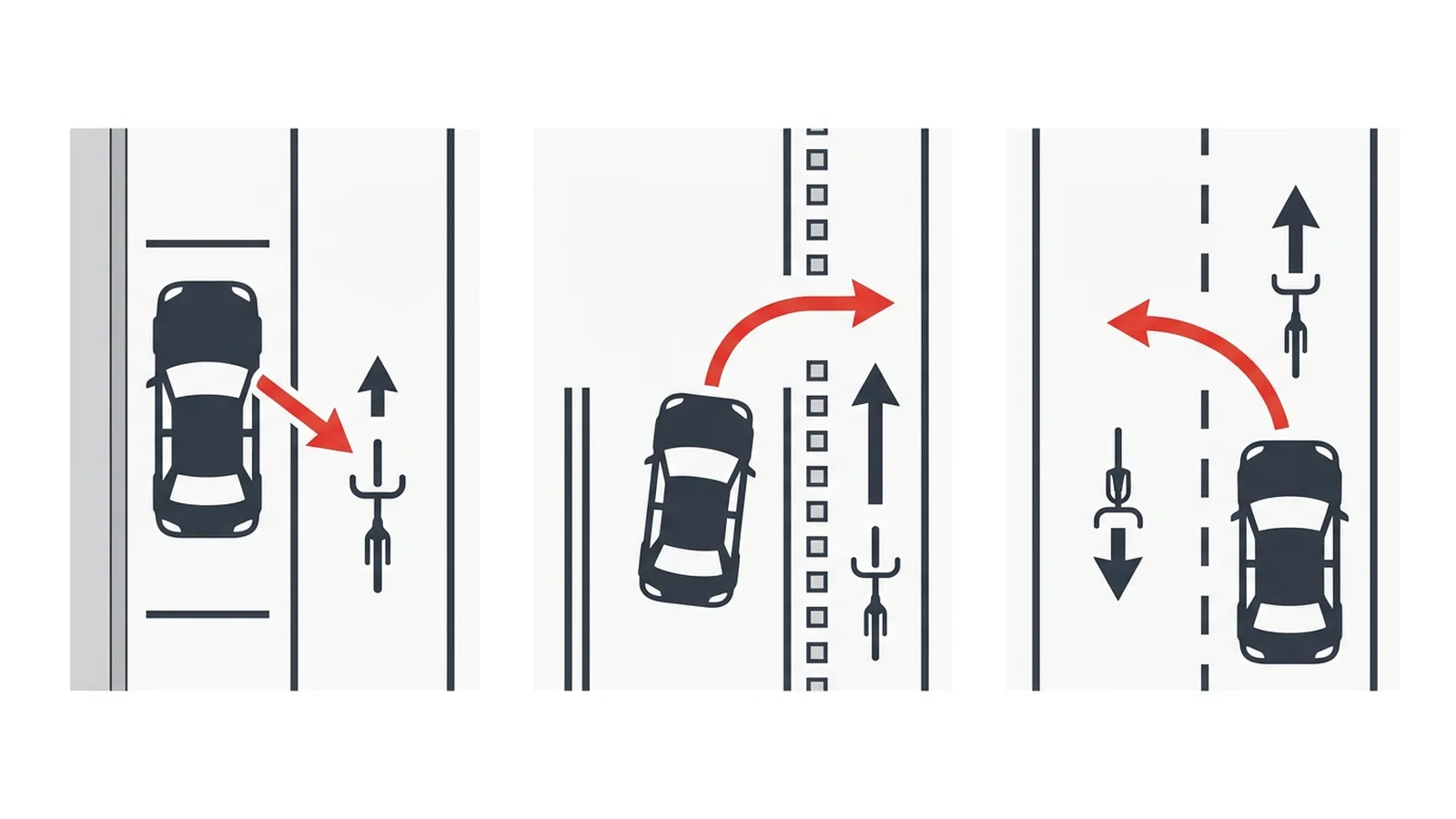
The most common is probably the door. Someone parks, turns the car off, pulls the keys out, and swings the door open without checking the mirror, and the cyclist rides straight into it. Turning off the engine doesn't end a driver's responsibility. You still have to look for a bike coming before you open the door, or open it slowly enough for a rider to see it and go around.
The second is the right hook. Picture a multi-lane road in a place like LA, three lanes going one direction, and a driver in the far right lane. Because they're in the far right lane, they're thinking only about the cars to their left. They aren't thinking about a bike coming up fast in the bike lane to their right. The driver slows to turn, the cyclist keeps going at full speed, and the gap between when the driver checks and when they start the turn may not match where the bike is. A driver can check the mirrors and look over a shoulder and still miss the cyclist in the blind spot. The safe move is to know the bike is back there and either finish the turn with plenty of room or wait for the rider to pass.
The third is the reverse: the left turn across traffic. A cyclist is coming straight toward the driver, and the driver turns left, either directly in front of the bike or into it. Either way, the driver is most likely at fault. On a two-lane road with an unprotected left, the cyclist has just as much right to go straight as any car does. A driver saying they didn't see the cyclist because it was a bike, or that the cyclist ran out into the intersection, doesn't change that. The cyclist was operating as a vehicle, and the driver needed to treat them like one.
Pedestrians, crosswalks and the driver's duty
Pedestrians are treated differently from cyclists, and the difference generally works in the pedestrian's favor. A bike moves with traffic, so the law treats it as a vehicle. A person on foot usually moves across or against traffic, so the law doesn't treat them as a vehicle, and they have a lot more leeway when fault gets divided.
In a marked crosswalk, or an unmarked one at an intersection, the driver has to yield to the pedestrian (California Vehicle Code section 21950). Crosswalks also exist to put drivers on alert. They aren't only for the moment someone is inside the lines. A driver approaching one should be scanning both sides for someone waiting to cross or about to step out.
Outside a crosswalk, the analysis shifts, but it doesn't flip. A pedestrian who steps out where there's no crosswalk may share some of the fault, maybe 20% or 30%, and the driver who hit them may still carry the rest. Jaywalking puts a larger share of the fault on the pedestrian. Someone crossing inside the crosswalk with the light, doing everything they're supposed to do, should carry none.
A common one is a busy crosswalk. People often are crossing like right on the outside of the crosswalk. Are they truly jaywalking if the crosswalk's like full? Maybe not.
The airport is a good example. There's one crosswalk and fifty people trying to use it at the same time, so some of them end up walking along the edges or just outside the lines. Would they carry fault for that? Possibly a little, something like 2% or 3%. That's very different from someone who steps out into traffic on a busy city street, who will likely carry a higher share. Being outside the lines is a fact about the case, not the end of it.
Two other places produce a lot of pedestrian injuries. One is parking lots and driveways, where a driver pulling in or out is focused on other cars and not on the person walking along the sidewalk. Those crashes tend to happen at lower speeds, but it doesn't take much speed for a vehicle weighing thousands of pounds to seriously injure someone with no protection at all.
The other is school zones. Kids aren't the best at watching their surroundings. They run across in front of a bus to get home, chase a ball into the street, or wander. That's exactly why we have reduced speed limits, signs, and the flashing lights that stop traffic around a school bus. Drivers carry a heightened duty around children. A child outside a crosswalk might carry some comparative fault, but a driver going 40 in a 25 school zone with kids around, not paying attention, is likely to be found nearly 100% at fault.
When the road itself is part of the case
Most bicycle and pedestrian cases are about a driver. Some are also about the road.
The coverage questions from Chapter 4 still apply. A cyclist hit by a driver with no insurance, or only the minimum, can turn to their own UM/UIM coverage, and MedPay on their own auto policy can help with early medical bills even though they were on a bike.
Beyond the driver, it's worth asking whether there have been a series of crashes in the same place. The Bayshore Bikeway is an example. There have been major wrong-way crashes there involving bikes and cars, and some resulted in very large verdicts. Those verdicts came from the roadway being designed in a way that was dangerous, specifically to cyclists, rather than from a driver carrying a lot of insurance.
When the road is part of the cause, other parties may be responsible: the public entity that owns the road, whoever designed it, whoever built it, or whoever failed to maintain it. A claim against a public entity runs on a much shorter clock than an ordinary claim, which can be as short as six months, so a crash that might involve the road itself is one to get looked at quickly. Understanding the vehicle codes, the right of way, and where bikes are and aren't allowed to ride is the starting point. Knowing the history of the stretch of road where it happened is what can widen the case.
Witnesses and the scene: what a cyclist loses first
The biggest one that happens is people don't get witness statements. Bicycles unfortunately don't have electronic data recorders. They don't have black boxes that tell us what was happening.
Without people who saw the crash, there's no way to answer the driver's version, which may well be the one most favorable to the driver. A cyclist is often hurt too badly to collect names and numbers, which is one more reason riding with someone else helps.
The second thing that disappears is the scene. A lot of riders get hit, drag the bike off the road, and sit down on the curb. If you can, don't move it. Sit down where you are and let a friend or a bystander take photos: where you were hit, where the bike ended up, what the road looked like, from more than one angle. Ideally the police see the bike where it landed. With heavy traffic, someone may have to move it, and if they do, get that person's information, because "I moved it from here to here" can matter later.
The same goes for the car. Drivers often pull over and move their vehicle after a crash, and then nobody gets to see how the collision happened. When we're reconstructing a crash weeks, months or years later, video, photos taken from different angles, and knowing who touched what are what let us show what happened.
Common Questions
- Who is at fault when a car hits a cyclist in California?
- It depends on how the crash happened, but a cyclist has the same rights on the road as a car, so the driver is often mostly or entirely at fault. On a left turn across an oncoming bike, I said on the podcast, "Either way, you're most likely gonna be at fault because that bike is treated as a car." A cyclist who skipped a signal may carry some comparative fault, but it's often minimal.
- How much room does a driver have to give a cyclist when passing?
- Three feet. "That's an actual vehicle code." It's California Vehicle Code section 21760. A driver who buzzes a cyclist instead of leaving that space, and then causes a collision, is likely to be found almost entirely at fault no matter what the rider was doing, because the driver was in direct violation of the statute.
- Is a pedestrian always in the right when hit by a car?
- Not always, but the rules lean their way. Drivers must yield to pedestrians in crosswalks and watch for people who might step out anywhere. A pedestrian outside a crosswalk can share some fault, but as I said on the show, "But just because someone was outside the crosswalk doesn't mean they're necessarily at fault or 100% at fault." Any share of fault reduces a recovery without ending it.
- What is a sharrow lane?
- A sharrow lane is a regular traffic lane marked with stenciled bikes, sometimes arrows or green paint, showing that cars and bikes share it. The name says it: "And the term sharrow essentially just means you can share the lane." You'll find them in a lot of beach cities. A cyclist has the same right to a sharrow lane as a car and may ride in the middle of it when it is too narrow to share.
- What should a cyclist do right after being hit by a car?
- Get the names and contact information of anyone who saw it, and leave the bike where it landed if you safely can. People often drag the bike to the curb. My advice: "Don't do that. Just sit down and then hopefully your friend or whoever else can take photos." Photograph the scene from several angles, and if anyone moves the bike or the car, get their information too.
Chapter Reflection
A bike or a pedestrian case is decided by who had the right to be in that space, and the injured person almost never starts out knowing the answer. The rules lean toward them more than they expect. A cyclist counts as a vehicle and a crosswalk protects the person in it. Near children, a driver answers to a higher standard. What the rules can't supply is proof. A cyclist doesn't carry a black box, so the case is made from the people who stood on the corner and the photos taken before anything was moved. Those disappear once the scene is cleared, and nothing later in the case can put them back.