
Before I can give anyone a sense of what their case might be worth, I need to know whose insurance is going to pay it and how much money is there. People tend to treat that as a back-office detail. It is one of the first things we look at, because the size of the policy shapes how and when a claim gets presented, and even how a client should think about their treatment while the case is open.
Most injured people never see the policy that ends up deciding their case. They see the other driver's insurance card at the scene, maybe a claim number, and then a letter. The limits, and the layers of coverage stacked above them, including the coverage in their own policy, stay invisible unless someone goes looking.
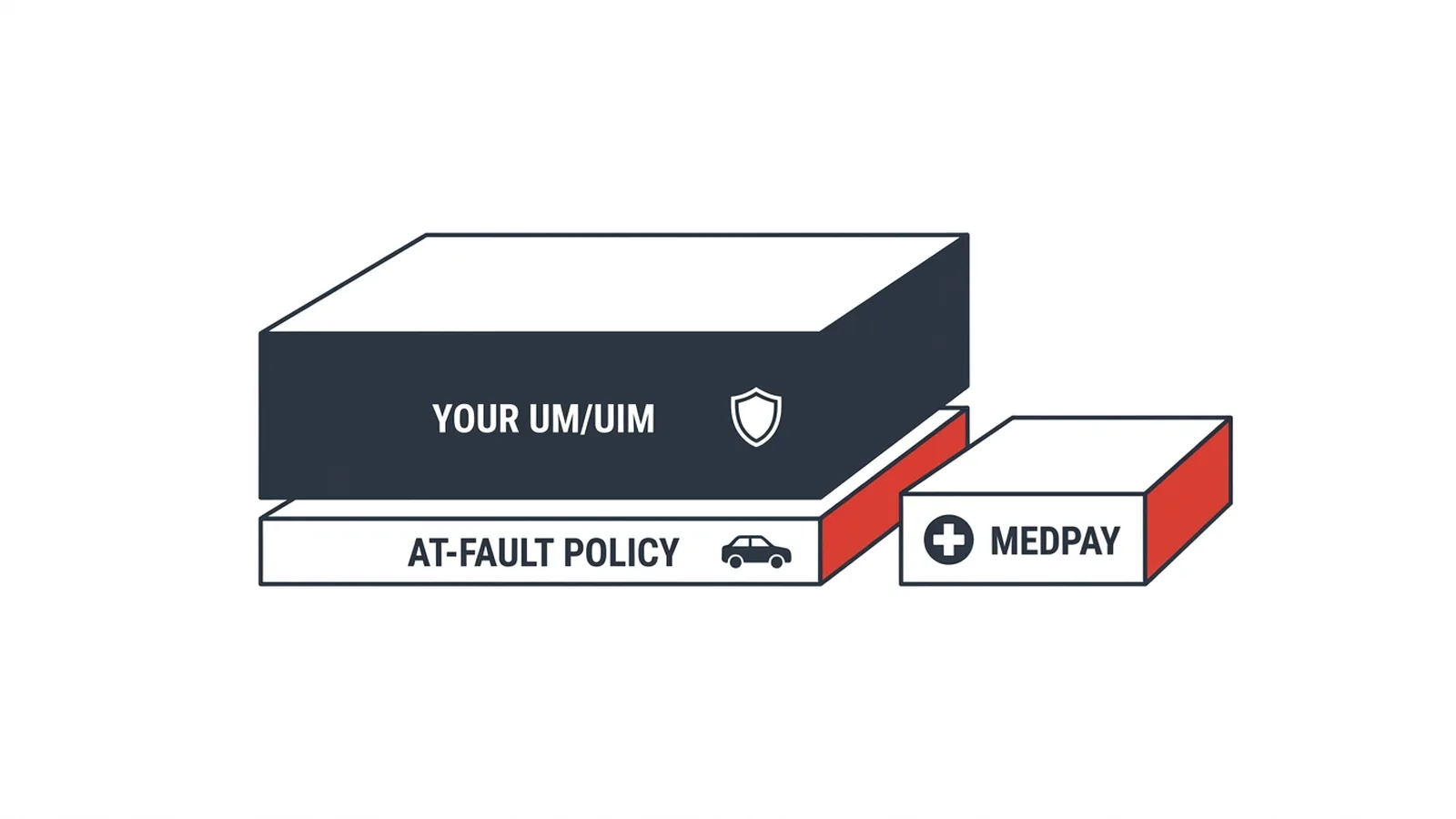
The layers come in order: the at-fault driver's policy, California's minimum coverage, your own uninsured and underinsured motorist coverage, MedPay, and what happens when an insurance company turns down a chance to settle inside its own limit. You don't need to become an insurance expert to follow it, and one of the questions you can check today by pulling out your own policy.
If you're anybody, you should be checking your policy today to make sure you have that. And if you don't have it, you should get it to the highest limit you can.
The other driver's policy limit comes first
When someone hits you, the first number that matters is the limit on their policy. If the insurance company or the other driver doesn't hand it over, we run a search. We do that on every single case, because until we know where the limits land, we can't plan the case around them.
Here's why it changes so much. Say you have a significant injury and the person who hit you carries a small policy. The last thing you want is to run up a mountain of medical bills against a policy that can never cover them. You'd end up upside down: the insurance company pays its limit, and you still owe more than you received. When there's a large policy behind the claim, you have more options treatment-wise, because the money that could eventually pay for that care exists.
The size of the policy also tends to predict how the other side behaves. With a very large policy, I expect low offers early on. With a small one, the insurance company may want to pay the limit right away and close the file. Neither response tells you what your injury is worth. Each one tells you something about the insurance company's own exposure. That's why the timing of a demand matters. As I put it in the brain injury episode, "if you're gonna be injured for a long time, we don't wanna run up $150,000 in medical bills and then find out there's only $50,000 in coverage."
California's minimum policy and how far it stretches
The state minimum in California is what's called a 30/60 policy. To put it in plain terms, if you were alone in your car and the person who hit you carried that minimum, the most you can collect from their policy is $30,000.
That sounds like real money until you've been through a serious crash. After a major impact, $30,000 may be one ER visit, and that's before anyone has started talking about lost wages or pain that lasts for years.
So when I see a serious injury against a minimum policy, the strategy shifts. The goal becomes getting the client paid on what's available, and then letting them continue treating through their health insurance or wherever else after the fact, so the future care doesn't eat into their settlement. They're going to need that money. Someone with a lasting injury may need assistance around the house, et cetera, and a settlement that has been swallowed by bills does nothing for them.
That is no reason to stop treating. It's a reason to know the number early, so the treatment plan and the claim plan are working together instead of against each other.
Your own uninsured and underinsured motorist coverage
Uninsured and underinsured motorist coverage, usually written as UM/UIM, is coverage you buy on your own policy that steps in when the person who hurt you has no insurance or not enough.
The math works like this. Say the at-fault driver has the $30,000 minimum and you carry $100,000 in UM/UIM. You can collect the $30,000 from their policy and then go to your own insurance for up to $70,000 more. That coverage follows you outside the car, too. It can apply when you're hit on a bicycle, the same as when you're hit driving.
We see it regularly: a major crash, whether it's a motorcycle, a bicycle or a car, and the person who caused it carried only the state minimum. When the injured person has UM/UIM, there's somewhere to go. When they don't, the case often stops at the limit no matter how badly they're hurt. That's the whole reason I tell people to check their own policy before they ever need it, and to buy the highest limit they can.
One thing catches people off guard. Once your UM/UIM is in play, your own insurance company is on the hook for some amount of money, and it's a business with its own money to protect. Its incentives start to look a lot like the other driver's insurer. Nobody has betrayed you. The coverage is built that way. It does mean you shouldn't assume a friendly call with your own carrier is a neutral conversation. Report the claim and report that you were hurt. Beyond that, talk to a lawyer before you talk through the details of your injuries with anyone's insurance company, your own included.
MedPay and paying the bills while the case is open
Medical bills start arriving long before a claim against the at-fault driver resolves, so the practical question early on is who pays them in the meantime.
MedPay is one answer. A lot of people have it on their auto policies without knowing it's there. It's coverage we can reach right away to help pay medical expenses, and it typically pays out regardless of fault. Even a driver who caused the crash, if they were hurt, can generally use their own MedPay. It applies in a bicycle accident as well.
Health insurance is the other piece, and it matters most in the small-policy situation above, where the client keeps treating through their health plan after the claim resolves.
What I'd steer anyone away from is the shortcut an insurance company sometimes offers early. A person mentions they're going to physical therapy, and the response is that the insurance company will take care of the therapy, just sign this. That piece of paper can be a release of the whole claim, signed months before anyone knows how serious the injury is. Or the promise is to cover all the medical bills, and when the bills come in, the answer changes. Your job in the early months is to get treatment and get better. Let the bills be someone else's problem to sort out, and don't sign anything an insurance company sends you without having it read first.
When a refused policy limit opens the door
The best way to show how coverage and documentation work together is a case I handled not too long ago.
A woman was T-boned at around 60 to 65 miles an hour. She had what you'd expect from that kind of impact: neck pain, back pain, a sore shoulder from the seatbelt. She also had a brain injury, and nothing in the first round of testing showed it. At the ER they did a CT and X-rays. The X-rays showed no fracture, and the CT showed no active brain bleed. Later she had an MRI, and it didn't show much either.
What she did have was a record. She told the ER her head hurt and she was dizzy. She followed up with her primary care doctor in the weeks after the crash and kept reporting what was happening: trouble focusing at work, light bothering her, terrible migraines, forgetting things, trouble finding words. Over time that record built a clear clinical picture. Her primary care doctor diagnosed it, the neurologist she was referred to diagnosed it, and later neurosurgeons and another neurologist agreed. More advanced imaging eventually showed dead spots in her brain.
The at-fault driver had a larger policy, I believe a million dollars. Somewhere around six months to a year in, we went to the insurance company and told them they needed to pay the policy. It was a lot of money, and it was a real brain injury that was going to last a long time. The answer was another offer, $150,000. We tried several more times. When they refused to work with us, we told them we were done negotiating and that we now considered the policy open.
That phrase is worth explaining. When an insurance company has been given enough information to pay its limit and chooses not to, in our view the limit stops being the ceiling on the claim. We stop negotiating inside it and go after the full value of what happened to the client.
That case got to within about two weeks of trial before the insurance company came back. It was resolved in a confidential settlement in the range of between $5 and $10 million, on a million-dollar policy. Every case turns on its own facts, and a result in one case doesn't predict the outcome of another. What made this one work was her documentation over time, more than the impact. She followed her doctors, she tried cognitive rehab, visual rehab and vocational rehab, and when nothing helped, the records said so.
We gave them an opportunity to pay the policy. They didn't take it. Well, now we're saying we're gonna go get whatever this claim is worth.
Common Questions
- What is the minimum car insurance in California?
- As I said on the podcast, "the state minimum in California is 30,000, 60,000." That's usually written as 30/60. For one person alone in the car, it means the most you can collect from the at-fault driver's policy is $30,000. After a serious crash, that can be gone after a single ER visit, which is why your own coverage matters so much when the other driver carries only the minimum.
- What is UM/UIM coverage, and do I need it?
- UM/UIM is uninsured and underinsured motorist coverage on your own policy. It pays when the at-fault driver has no insurance or not enough. In my words from the show: "Well, if you have UM/UIM, you can then tap into your own insurance." If the other driver paid $30,000 and you carry $100,000, you can collect up to $70,000 more from your own carrier. I tell everyone to check for it and carry the highest limit they can.
- What is MedPay and who can use it?
- MedPay is medical payments coverage on an auto policy. As I described it, "MedPay is coverage we can get right away to help cover medical expenses or help offset medical expenses." It typically pays regardless of fault, so even a driver who caused the crash can generally use their own MedPay if they were hurt. It applies when you're injured on a bicycle as well. Many people carry it without realizing it's on their policy.
- What happens if the insurance company refuses to pay its policy limit?
- If an insurance company had enough information to pay its limit and refused, we treat the policy as open and pursue the full value of the claim instead of negotiating inside the limit. In the T-bone case from this chapter, I told them: "Okay, thanks. We're done negotiating, and we now consider that policy open." That case was resolved confidentially well above the policy. Results depend on the facts of each case.
- Will my own insurance company help me after an accident?
- Your own carrier is a business, and once your UM/UIM is in play, it may owe you money. That means "they may have similar incentives to the other driver's insurance to not pay the claim if they're worried about you tapping into their insurance." That doesn't make them an enemy. It means you should report the claim and the injury, then let a lawyer handle the conversations about your treatment and your damages.
Chapter Reflection
Coverage is the part of an injury case nobody sees, and it quietly sets the boundaries for everything else. A minimum policy changes how we pace treatment and when we make a demand, while a large one changes what the other side will fight over. A refused limit can change the size of the whole case. Almost none of that is in your control once the crash has happened. The one piece that is, the coverage on your own policy, has to be decided long before you ever need it, and that's the reason to look at it now rather than after the fact.