
Truck Accident Claims: Why a Commercial Vehicle Case Is Nothing Like a Car Crash
When two passenger vehicles collide in California, whether it's a sedan, an SUV or a pickup, I treat it as a personal auto case, and California's rules govern it. When one of those vehicles is a commercial truck, the case changes shape from the first phone call. The driver and the company are held to a different set of rules. The list of people who may be responsible gets longer. The injuries tend to be far more serious, and the insurance tends to be far larger. And the evidence that decides the whole thing usually sits with the company that has the most riding on it.
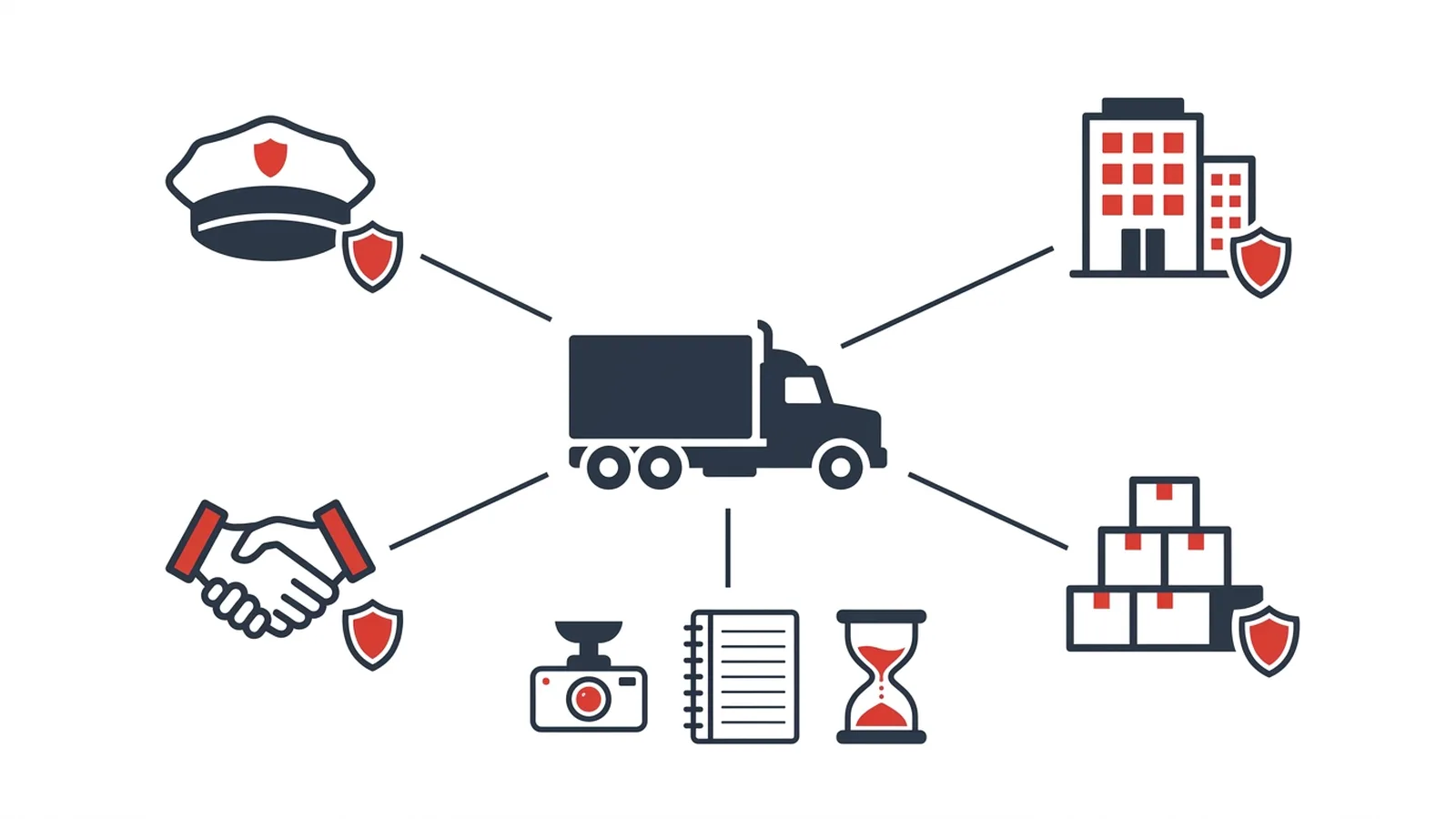
I'll walk through those differences the way I explain them to the people who hire us: why weight matters more than size, what the recording equipment inside a truck captures, who besides the driver can be responsible, why the clock on evidence starts the moment the crash happens, and what one piece of video did in one of my own cases. These pages show where these cases are won, which is early, and why the other side already knows that.
Trucking companies send people out to the scene of the accident, like the day of, if not the next day. They'll fly people all over the country to go to a scene, quote, 'preserve the scene,' but preserve the scene in a way that's most favorable for the trucking company.
Federal safety rules, and why weight matters more than size
Truck drivers and trucking companies are held to federal safety regulations, and those regulations are stricter than the rules that apply to someone driving their own car. A truck is more dangerous than a passenger vehicle because it is so much bigger and so much heavier, and when it hits a person or a car, that difference is what does the damage.
People tend to picture an 18-wheeler when they hear "truck case," but the category is wider than that. A dump truck or a cement mixer can be smaller than a traditional big rig and still carry an enormous amount of weight, and for the way I evaluate a case, those vehicles belong in the same bucket as the 18-wheeler. When we're talking about force and impact on a human body, the weight and mass of a vehicle matter a lot more than its size. A massive 18-wheeler running completely empty is still heavy, but it can weigh a lot less than a fully loaded cement mixer packed into a smaller frame.
That is the first adjustment I ask clients to make. What matters is how much the truck weighed when it hit you, more than how big it looked in the mirror, and which rules its driver and its owner were supposed to be following when it did.
More responsible parties, and more insurance, than a car crash
In a normal car accident there is usually one driver and one policy to look at. In a truck case, the driver may be the least important party in the room. The driver might get a point on his license, but the company has a lot more to lose, and it is typically the company that ends up responsible.
The list can include the driver's employer, the logistics company or freight broker that coordinated the shipment, and the shipper or cargo loader that put the load on the truck. A freight broker is essentially the business that arranges for pieces of freight to get from one place to another, and that coordinating role can carry responsibility of its own. A loader that overloaded the truck, or failed to secure what was stacked on a flatbed, can be liable in addition to the driver when things come off and cause a massive accident. Where the trucking and shipping relationships are complicated, I have seen as many as five, six, seven or eight parties share responsibility for one person's injuries.
Each of those parties may carry its own insurance. The driver may have a different policy than the carrier. The person who loaded the cargo is going to have a different policy than the trucking company. Some of these companies are self-insured, and some have layers of coverage stacked on top of each other. Working out who is who, and which policy sits where, is a big part of the legwork on our end.
We also look hard at how the company hired. Have they put bad drivers on the road before? Do they have a poor safety record? Were they willing to overlook a criminal record, or a history of drug or alcohol abuse? In a lot of ways, a trucking case is part employment case and part personal injury case, and it takes a truck accident attorney who knows how to work in both worlds.
The employment side matters most when a company says the driver isn't theirs. A large retailer or delivery company may say its driver is an independent contractor, so the company isn't responsible. Shipping companies with large fleets sometimes run a lot of their drivers on 1099s for exactly that reason. But if the company controls the route, provides the truck, and tells the driver when to pick up and when to deliver, then at least in California the law is going to treat that driver as an employee very frequently, if not every time. The label on the paperwork is not the end of the analysis.
All of this feeds into value. Truck cases tend to carry higher value, but not because a broken arm is worth more when a truck causes it. The injuries in these cases are usually far more serious and need compensation over a much longer period than a typical low-speed rear-end crash, and the coverage is far larger to match. A personal auto policy in California can carry as little as $30,000. Commercial trucks carry much larger policies, often with umbrella coverage above them, so there is a much bigger bucket of money available when someone is badly hurt.
That doesn't mean you can't have massive injuries on a personal auto case. It doesn't mean you can't have minor injuries in a trucking case. It just means it's more likely that you're gonna have more significant injuries involving a massive truck than you are involving a Honda Civic.
The black box, the dash cam and the retention clock
Most commercial trucks carry recording equipment. Trucks generally have to run an electronic logging device, and they carry what people call a black box. Between them, that equipment shows when the driver was driving and when he wasn't, how fast the truck was going, when the driver braked, and oftentimes the steering inputs. Newer passenger cars carry some of the same technology, but in a truck it is standard, and a lot of trucks now have dash cam footage on top of it.
That is good news for an injured person, because the truth of the crash is usually recorded somewhere. The catch is that the recording does not last. Electronic logs work like security footage: they get written over. Every company sets its own document retention policy, and when the footage is not favorable to the company, a shorter policy suits it better. If the policy says the data is kept for a week and the request arrives on day eight, the data is gone, and the company can say it did nothing wrong. A company with no lawyer's letter in hand has no incentive to hang on to anything.
That letter is called a preservation letter. It tells the company, in writing, that it cannot destroy the logs, the dash cam video or the other evidence from the crash. When we get preservation letters out the day of the crash or the day after, we can make sure most of that material is still there later. This is the single question I'd want every person hurt in a truck crash to ask their lawyer: did a preservation letter go out? If the answer is no, I would be looking for a different lawyer.
The video an insurer would not produce
One of my clients was deaf. She was T-boned by a large box truck, and in the early days of the case we reached out to the trucking company's insurance company and asked for the truck's video. They told us they had already sent it. I said I never got it and asked them to send it again, addressed to me. They said sure, and then nothing came. A month later I followed up, and I was told the problem was with our system. When I asked them to send it another way, they said that wasn't their job.
At the same time, they told us the logs and the video showed our client had run the red light and was 100% at fault, and that they planned to go after her for their cost of defense. I thought that was strange. If a company has video that clears its driver, producing it early ends the claim and saves the cost of defending it. Even a company confident of winning at trial still pays to get there. Evidence that helps a defendant usually comes out fast. Evidence that is being dodged that hard usually means something is on it.
So we filed suit. In discovery we requested the video repeatedly, and they refused, and then they said it didn't exist. Finally a judge ordered them to produce it, in large part because of what they had told us before the suit: that they had it and were sending it. When we got the video and the logs, the logs showed the truck was moving at the time they said our client ran the light, and the video showed their driver ran the light. No other car had run it. Only the truck had, and the video showed the impact directly.
The police report had gotten it wrong, and it's worth understanding why. Because our client was deaf, she couldn't communicate with the officers at the scene. The report didn't say she was 100% at fault, but it did put her at fault, and it said nothing about the truck having a dash cam. What saved the case was something she did herself. Right after the crash, she signaled to people around her and got them to write down their names and phone numbers. A couple of those witnesses told us they remembered seeing a camera in the truck's windshield. That is how we knew what to fight for.
The offer on that case started at zero, and arguably below zero, given the threat to pursue costs against her. As I recall, the case settled for well over the million-dollar policy, because of what the company had said early on. Every case turns on its own facts, and a past result doesn't predict another one. What that case shows is how much can hinge on a single piece of evidence, and on someone insisting it be produced.
Protecting the case in the first days
The most common mistakes after a truck crash are the same ones I see after every crash: not going to a doctor, talking too much to the insurance companies at the beginning, and misspeaking to the police. Right after a crash, people are nervous and shaken, they're not thinking clearly, and they assume the police and the insurance companies are there to help them. That isn't necessarily the case. This is no criticism of police officers. They are doing their best to reconstruct something they didn't see, and they often reach quick judgments based on where things ended up. I've seen plenty of crashes where vehicles landed in places that made no sense until a biomechanical expert came in and showed why it happened that way. Once an officer has a theory, it's easy to hear only the facts that fit it.
If you're awake and coherent at the scene, even if you're far from feeling fine, try to get witnesses' information quickly. It doesn't need to be perfect. A first name and a phone number is enough, as long as you follow up with them a short time later. I would much rather a client make that follow-up call than make it myself, because a witness who hears a lawyer on the line instantly goes on guard. A witness who hears from the person they watched get hurt is far more willing to help.
Photographs matter for the same reason. If you're badly injured, don't get up and start taking pictures. But if someone else is there, ask them to take photos and send them to you, and you can ask the police to take photos and send them too. Once the vehicles are moved, the scene becomes a blank canvas and everyone is guessing. Photos of where the vehicles came to rest and where the debris landed show where the impacts happened, and they can show speed.
Then make sure the hospital writes down every symptom, not only the one that hurts most, for the reasons Chapter 3 lays out. The same goes for every provider along the way. After a serious crash, people forget that they went by ambulance to a trauma center for three days before the hospital where they spent the next week, or they forget the doctors who saw them before their main one. Those early records can be the proof that the symptoms were there from the very beginning, so gathering them early matters.
Common Questions
- Why is a truck accident case different from a car accident case?
- A truck case is held to stricter federal safety regulations, involves a far heavier vehicle, and usually involves more than one responsible party. Trucks carry logging devices and often dash cams that record what happened, and that data can be written over on a short cycle. The injuries tend to be more serious and the insurance larger, so the case takes more legwork to sort out who is responsible and which policies apply.
- Who can be held responsible for a truck accident besides the driver?
- Often the driver's employer, plus the freight broker that coordinated the shipment and the shipper or loader that put the cargo on the truck. A company may call its driver an independent contractor, but when it controls the route, the truck and the schedule, my position is plain: "For our purposes, that person's an employee." In California, that driver is very frequently treated as an employee under the law.
- What is a preservation letter and why does it matter?
- A preservation letter is a written demand that the trucking company keep its logs, dash cam video and other evidence from the crash. Without one, that evidence can be overwritten under the company's own retention policy, which may be short. Sent the day of the crash or the day after, it keeps most of that material available. Anyone hurt in a truck crash should ask their lawyer whether one went out.
- What should I do at the scene of a truck accident if I am able to?
- If you're awake and able, get witnesses' contact information and photos of the vehicles and debris, or ask someone else, including the police, to take photos and send them to you. Witness details don't have to be complete: "A first name and a phone number is fine as long as you then follow up with them a short time later." Then get medical care and report every symptom.
Chapter Reflection
A truck case is a race between two clocks. One is the company's retention policy, quietly writing over the logs and the video. The other is the injured person's recovery, which can take months to show how serious the harm is. My client who was T-boned by that box truck had no idea that a camera in a windshield would decide her case. She did one small thing right, she got names and numbers from the people who saw it, and that gave us something to pull on. Most of what wins a truck case is like that: ordinary steps taken early, before the other side has finished deciding what the scene looked like.